Short Term Disability Insurance in Canada (2026): What It Actually Covers, and Why EI Isn’t a Backup Plan


Educational content. Examples are hypothetical.
Most disability claims aren't the dramatic kind. They're a torn ACL from a weekend soccer game, a bad flu that turns into pneumonia, six weeks recovering from a scope on a bad shoulder. Short term disability insurance is the coverage built for exactly that stretch: it replaces a portion of your income, usually 70 to 75 percent of salary, for a disability that keeps you off work anywhere from about a week up to roughly a year, and for most working Canadians it arrives through a group plan at the office rather than a policy anyone shops for on their own.
That last part matters more than it sounds. Short term disability, often shortened to STD or called weekly indemnity, is overwhelmingly a group insurance product. Very few insurers sell a stand-alone short-term policy to an individual off the street. If you have it, you almost certainly have it because your employer, union, or professional association built it into your benefits package, which means the moment you leave that job, or if you never had that kind of employer, the coverage disappears with you.
How short term disability actually pays out
Inside a typical employer plan, STD is designed to bridge the early weeks of a disability before longer coverage takes over. Benefits usually begin after a seven-day waiting period for an illness, or from the first day for an accident, and the payout is calculated as a percentage of your regular salary, most often in the 70 to 75 percent range. That percentage is higher than what long-term disability plans pay for a specific reason: STD benefits are almost always taxable, because the employer pays 100 percent of the premium, so the higher percentage is partly clawed back by income tax before it reaches your bank account.
The maximum benefit period under a group STD plan is almost always 12 months, at which point, if you're still disabled, the file transitions to the plan's long-term disability coverage, provided your employer offers one.
The definition of disability driving that payout matters, because the wording that group plans use is easy to misread if you've heard the term "own occupation" used elsewhere in insurance. In a group short-term plan, "own occupation" simply means you can't perform the duties of your regular job. But if your employer offers you a related role you're capable of doing, you have to take it or lose the benefit; you don't get to decline and keep collecting.
That's a meaningfully stricter standard than the "own occupation" definition used in some individually owned, personally underwritten disability policies, where the insured can be paid in full even while working an entirely different job, because the trigger is simply the inability to do the original occupation, full stop.
The label is the same word in both places. The rights behind it are not, and it is exactly the kind of gap a client discovers only at claim time if nobody walked them through it beforehand.
The label is the same word in both places. The rights behind it are not, and that gap usually gets discovered only at claim time.
How is this different from EI sickness benefits?
People without a group plan, or with a thin one, often ask how this compares to EI. The honest answer is that Employment Insurance sickness benefits are a much smaller safety net than most people assume. To qualify, you need to have worked at least 600 insurable hours in the preceding 52 weeks and have seen your income drop by at least 40 percent because of the illness, injury, or quarantine. Once approved, EI sickness benefits pay 55 percent of your average insurable weekly earnings, up to a maximum weekly amount, after a one-week waiting period, for up to 26 weeks.
Two features of that structure catch people off guard. First, the maximum is a hard ceiling: someone earning well above the insurable maximum receives the same capped weekly amount as someone earning right at it, so the higher your income, the smaller the real percentage EI actually replaces.
Second, EI is what's called a second payor against most other disability income sources. If you're already receiving group STD, workers' compensation, or CPP disability, EI tops up only the difference, dollar for dollar, and pays nothing at all once those other sources already meet the maximum. The one exception is a personally owned individual disability policy, which EI does not offset against, which is one of the practical reasons an individually owned policy is worth having even for someone who already carries a group plan.
| Group short-term disability | EI sickness benefits | |
|---|---|---|
| Who provides it | Employer, union, or association group plan | Government of Canada |
| Typical income replacement | 70-75% of salary | 55% of average insurable earnings, up to the annual maximum |
| Waiting period | 7 days (illness), first day (accident) | 1 week |
| Maximum benefit period | Usually 12 months | Up to 26 weeks |
| Taxable? | Usually yes (employer pays the premium) | Yes |
| Offset against other benefits? | Coordinates with EI as first payor | Second payor; reduced dollar-for-dollar against most other sources, except personally owned individual disability policies |
| Available without an employer plan | No | Yes, if you meet the hours and income-drop test |
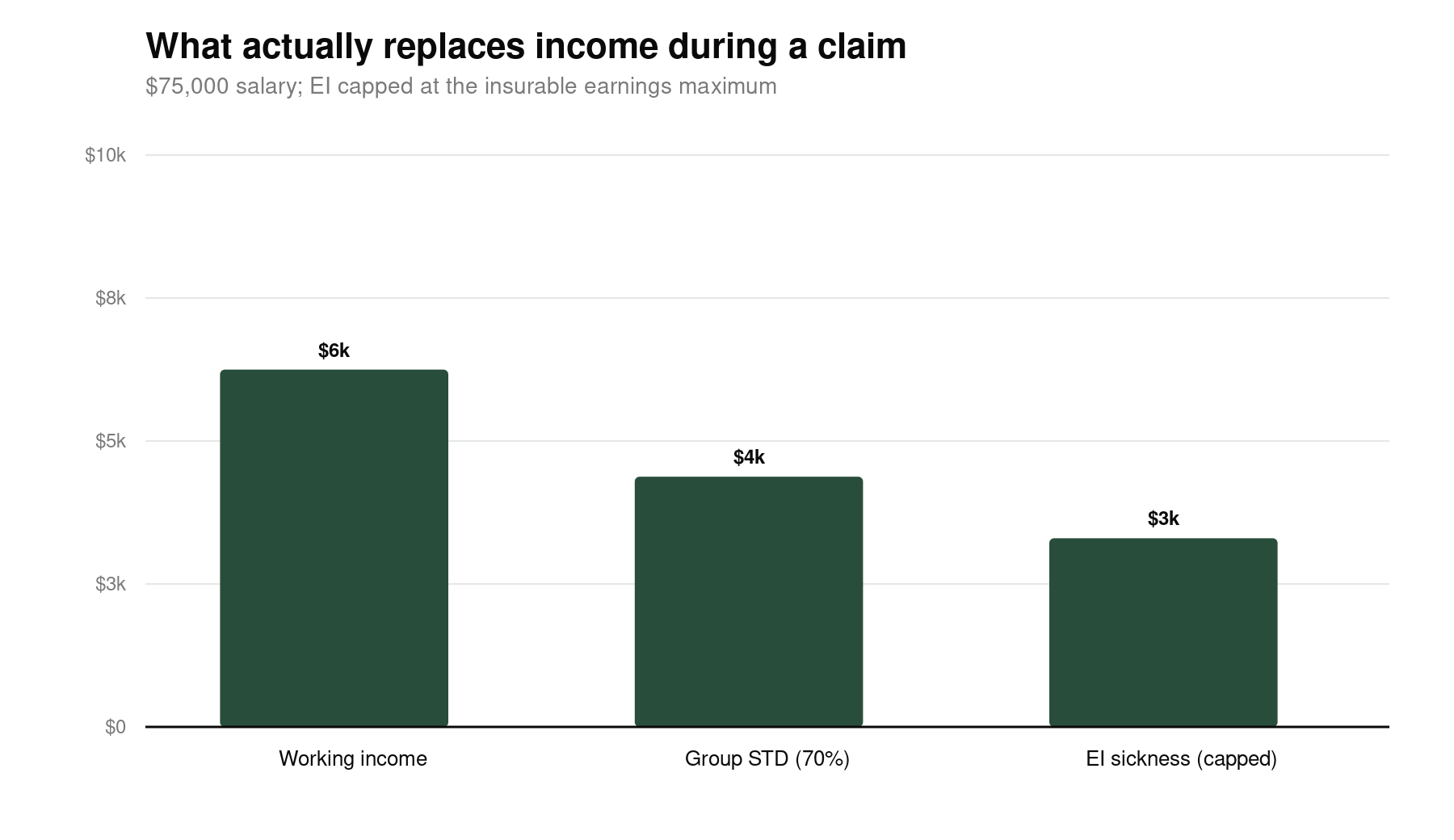
The gap this table points to is common in practice: a self-employed consultant, a commissioned salesperson, or a contract worker with no employer STD plan can end up relying on EI as though it functions like a paycheque, when it was never built to. The 26-week cap, the 55 percent formula, and the earnings ceiling together mean EI covers a real but modest slice of income, and it stops well before a long recovery does.
What happens if you're still off work after short-term benefits end
If a disability outlasts the short-term benefit period, the claim doesn't just stop. Under most group plans it converts into long-term disability, typically at a lower percentage of salary but on a tax-free basis, and often under a stricter definition of disability that shifts from "unable to do your own job" to "unable to do any job you're reasonably suited for" somewhere around the one- or two-year mark. It's easy to assume the transition is automatic and smooth. It usually is, but the definitions and the payout percentage both change, and that's worth understanding before you're the one relying on it.
Take a marketing manager earning $75,000 a year, off work for shoulder surgery and recovery. Her group STD pays 70 percent of salary, taxable, for the first 12 months. If she's still unable to work at month 13, her file shifts to the group's LTD coverage, now paying 60 percent of salary but tax-free, under a definition that, after the first year of LTD, asks whether she can do any job suited to her training and experience, not just her old one.
Self-employed and no group plan? This is where the real gap sits
If you're self-employed, work on contract, or your employer simply doesn't offer STD, you have two options worth understanding rather than one default. EI special benefits are available to self-employed workers, but only if you opt in ahead of time and pay both the employee and the employer portion of the premium yourself; it isn't automatic, and it isn't retroactive once you're already sick. The second option is an individually owned disability policy with a benefit period built for shorter claims, underwritten specifically for your income and occupation class, which pays tax-free and isn't offset by EI.
Consider a hypothetical self-employed consultant who assumes EI will function like an employer plan. They would discover the 40 percent income-drop test and the 26-week cap only when they needed the money, and by then it would be too late to fix cheaply. If this sounds like your situation, an individual policy sized to your real income, not a rough guess, is the conversation worth having before anything happens, not after.
Is short term disability insurance worth carrying on its own?
The honest read: for most salaried employees with a solid employer STD plan, the coverage does its job quietly in the background and doesn't need much more attention than confirming what it actually pays and for how long. Where it falls short is at the edges, self-employment, contract work, and group plans that cap out low relative to income, and in every one of those cases the fix isn't necessarily more short-term coverage. It's usually making sure the handoff to long-term protection is solid, since a six-week absence rarely bankrupts a household but a two-year one can.
That's a needs-analysis question, not a shopping question. Start with a free Gap Assessment to see the size of it in about two minutes, or go straight to a Gap Review to answer it properly: what you actually have, what it actually pays, and where the real exposure sits once the short-term coverage runs out.
Frequently asked questions
Does short term disability insurance cover pregnancy or parental leave? Group STD plans generally exclude normal pregnancy and delivery from disability coverage, since maternity and parental leave are handled through EI's separate maternity and parental benefits rather than through sickness or disability provisions. A pregnancy complication that goes beyond a normal delivery may be treated differently depending on the specific plan wording.
Is short term disability insurance income taxable? Usually yes, when the employer pays the premium, because CRA treats employer-paid group STD premiums as making the resulting benefit taxable income to the employee. If an employee pays the full premium themselves with after-tax dollars, the benefit is instead received tax-free, mirroring the tax treatment of an individually owned policy.
What's the difference between short term and long term disability insurance? Short term disability covers the earlier, typically shorter phase of a disability, usually up to about 12 months under a group plan, paid at a higher percentage of salary but usually taxable. Long-term disability picks up afterward, generally paying a lower percentage but tax-free, often running to a benefit period ending at age 65. Our guide to the five sources of disability income protection maps out how all the pieces, including this one, are meant to fit together.
Can a self-employed person get short term disability insurance? Not through an employer group plan, since there isn't one, but a self-employed person can pre-register for EI special benefits (paying both premium portions) or purchase an individually owned disability policy underwritten for their income and occupation, which pays tax-free and isn't reduced by EI.
How long does short term disability insurance last? Group short-term disability benefit periods are almost always capped around 12 months, though the range across policies can run from about 10 to 26 weeks for some individually structured short-benefit-period plans. After that, a continuing disability typically shifts to long-term disability coverage where one exists.
Disclaimer
This article is general information for Canadian consumers, based on LLQP curriculum and public regulatory material. It is not financial, tax, or legal advice, and nothing here is a quote or guarantee. Any dollar figures, charts, or client scenarios used as examples in this article are hypothetical illustrations only, not based on real clients, and not tied to any specific insurer or product. Speak with a licensed advisor about your own situation.
About your advisor
Brenda Nkwocha and Hilda Chukwu are licensed life insurance advisors in Ontario. They lead with your gap, not a product: a straight look at what you actually have and what you actually need, explained in plain language before anything is recommended. This article is for educational purposes only and isn’t a quote, an offer, or personalized advice.
Two minutes now beats a guess you can’t take back.
See the size of your gap, then decide what to do with it.