Mortgage Life Insurance vs Life Insurance in Canada (2026): The Difference Your Bank Won’t Walk You Through


Educational content. Examples are hypothetical.
Most homeowners are offered "mortgage protection" by the same bank that approved their mortgage, often in the same appointment, sometimes on the same signature page. Most assume it's just life insurance with a different name. It isn't. Mortgage life insurance, more precisely called creditor insurance, is a group policy the bank owns on your life, sized to your loan and payable to the bank.
Personal life insurance is a policy you own, sized to whatever your family actually needs, and payable to whoever you name. The bank's version protects the bank's balance sheet first. Yours protects your family first. Both can have a place, but they are not interchangeable, and the choice matters more than the five minutes most people spend on it at the lender's desk.
Mortgage life insurance: who actually owns the policy
The single fact that explains every other difference between these two products is who the policyholder is. With bank-sold mortgage insurance, the policyholder is the financial institution, not you. You're a member of a group plan the bank has negotiated, in the same way an employee is a member of a workplace benefits plan. The bank sets the terms, the bank is named the beneficiary, and the bank decides how much gets paid out, which is capped at whatever you still owe on the mortgage at the time of your death. If you have paid the loan down to $180,000, that is the most your family will ever see from that policy, regardless of what you originally applied for.
With a personal life insurance policy, you are the policyholder. You choose the face amount, you name the beneficiary, and nothing about the payout is tied to a loan balance unless you specifically structure it that way. If your spouse is the beneficiary of a $500,000 term policy, they get $500,000 whether the mortgage is paid off, refinanced, or gone entirely because you sold the house two years ago. The money follows your family, not a lender's ledger.
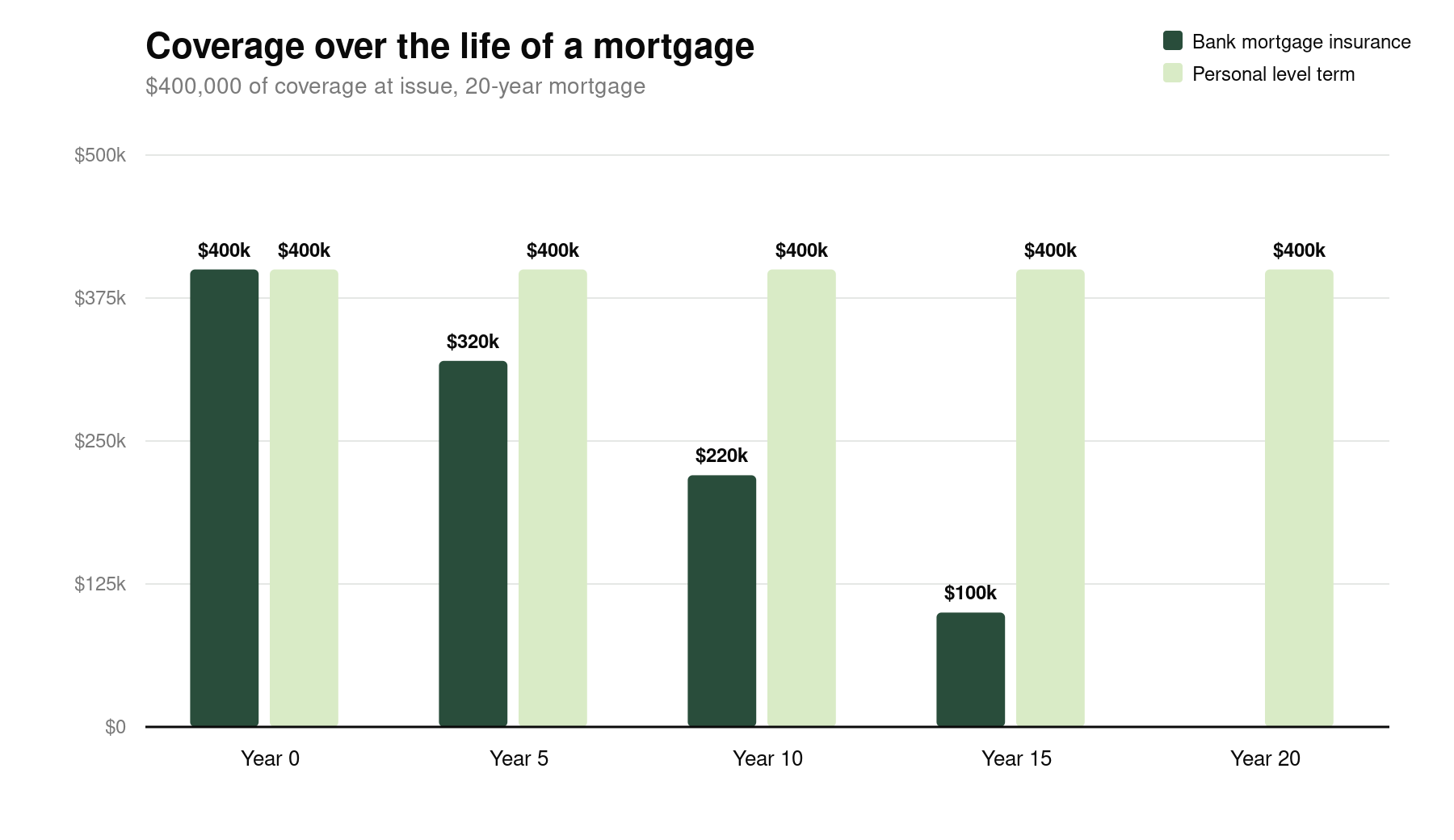
The coverage shrinks either way, but only one version shrinks your protection with it
Bank mortgage insurance isn't simply the "matching" option it looks like. It's built as a form of decreasing term insurance: the death benefit declines over time in step with your amortization schedule, while the premium is typically charged as a flat rate that does not fall along with it. So the actual cost of the insurance, per dollar of protection, rises every year you hold it, even though your bill looks the same.
Personal term insurance, by contrast, is overwhelmingly sold with a level death benefit. Decreasing term is actually uncommon in the individual market in Canada today; most insurers reserve it for group and creditor products, which is exactly the mortgage insurance you're being offered at the branch. That means a personal policy sized to your current mortgage generally keeps paying the full amount for the life of the term, even after your mortgage balance has fallen well below it. Your family isn't limited to "whatever is left on the loan." They get the number on the contract, and they decide whether that pays off the house, covers a few years of income, or does both.
What happens when you switch banks or renew with someone else
This is the part that catches people off guard, usually years after they signed up. Because the bank is the policyholder and the coverage is tied to that specific loan, it generally doesn't travel with you. Renew your mortgage with a different lender at your next term, or pay off the loan and refinance elsewhere, and the creditor coverage tied to the original loan typically ends. You are back to applying for new coverage, at your new age, with whatever health issues may have shown up since you first signed, and no guarantee of the same price or the same approval.
A personal life insurance policy has nothing to do with any particular lender, unlike mortgage life insurance. It stays in force on the schedule you chose when you bought it (many are renewable and some are convertible to permanent coverage later) regardless of who holds your mortgage or whether you still have one at all.
The underwriting timing problem: paying premiums for years does not guarantee a paid claim
The most consequential structural difference is when the insurance company actually checks your health. Bank creditor insurance is typically sold with a short list of yes-or-no health questions and little else at the time you sign, which is why it feels so painless to add at the closing table. The fuller underwriting, the real look at your medical history, often doesn't happen until a claim is filed. This is called post-claim underwriting, and it means a beneficiary can be told, after years of paid premiums, that the application understated a condition and the claim is being denied. There is no way to know in advance whether this will happen to a given policy, which is precisely the risk.
Personal life insurance does its underwriting up front. You disclose your health, sometimes take a paramedical exam, and the insurer decides your risk class before the policy is issued, not after you've died. Once two years pass from issue (the contestability period), the insurer can only void the policy for fraud, not for an honest mistake on the application. Your family gets that certainty while you're still alive to sort out any problems with the disclosure, not after.
An illustrative comparison
A hypothetical example
Consider a hypothetical couple, Priya and Marcus, who bought their first home and signed up for the bank's mortgage protection at the closing appointment because it was one more form in a stack they were already signing. They are both 34, non-smokers, in good health. When their advisor ran a gap review, the math was straightforward: for roughly what they were already paying the bank, a 20-year personal term policy with a level $450,000 benefit on each of them, naming each other as beneficiary, gave their family more protection in year 15 of the mortgage than the bank's shrinking coverage would have paid out in year one.
So which one is right for you
If you are insurable, meaning you can pass medical underwriting without a serious rating, a personal term policy sized to your mortgage plus your other obligations is almost always the stronger structural choice. You control the beneficiary, the coverage doesn't erode faster than your actual need, and the underwriting happens while you're alive to answer questions about it. (If you are weighing how long that term policy should run, our term vs. whole life insurance comparison walks through how to size the term to the actual life of the need.)
Bank mortgage life insurance still has a real role for people who cannot pass medical underwriting elsewhere, who want zero-effort enrollment and accept the tradeoffs, or who want a small supplementary layer alongside a personal policy rather than in place of one. It is not a scam, and it is not worthless. It is simply debt insurance dressed up to look like family protection, and the two are worth pricing and comparing side by side rather than accepting on autopilot at the lender's desk.
It is simply debt insurance dressed up to look like family protection.
Frequently asked questions
Is mortgage life insurance the same thing as life insurance? No. Mortgage life insurance (creditor insurance) is a group policy owned by your lender, with the lender as beneficiary and the payout capped at your outstanding loan balance. Personal life insurance is a policy you own, with a beneficiary you choose and a death benefit that isn't tied to any specific debt.
Do I have to buy mortgage insurance from my bank to get approved? No. Under Canadian Life and Health Insurance Association guidelines, creditor insurance must be disclosed as voluntary and cannot be a condition of mortgage approval. You can decline it and arrange your own coverage instead.
What happens to my mortgage insurance if I switch lenders? Because the coverage is tied to that specific loan with that specific lender, it typically ends when you switch lenders or pay off and refinance elsewhere. You would need to apply for new coverage at that point, at your then-current age and health.
Can a mortgage insurance claim be denied even after years of paid premiums? Yes, this is a real risk with creditor insurance because full underwriting is sometimes deferred until a claim is filed, a practice called post-claim underwriting. Personal life insurance underwrites your health up front, so once the contestability period passes, the insurer can only deny a claim for proven fraud.
Is personal term life insurance more expensive than bank mortgage insurance? Not necessarily, and it often works out cheaper per dollar of protection for healthy applicants, because creditor insurance charges a flat group rate to everyone in the pool while personal term pricing reflects your individual age, gender, and health class. The only way to know is to compare an actual quote against your mortgage insurance premium.
The honest way to know which structure fits your situation, and whether you're already carrying the wrong one, is a full picture rather than a guess at the closing table. Start with a free Gap Assessment, a two-minute look at the size of your gap, or go straight to a Gap Review if you are ready to map it against your real numbers.
Disclaimer
This article is general information for Canadian consumers, based on LLQP curriculum and public regulatory material. It is not financial, tax, or legal advice, and nothing here is a quote or guarantee. Any dollar figures, charts, or client scenarios used as examples in this article are hypothetical illustrations only, not based on real clients, and not tied to any specific insurer or product. Speak with a licensed advisor about your own situation.
About your advisor
Brenda Nkwocha and Hilda Chukwu are licensed life insurance advisors in Ontario. They lead with your gap, not a product: a straight look at what you actually have and what you actually need, explained in plain language before anything is recommended. This article is for educational purposes only and isn’t a quote, an offer, or personalized advice.
Two minutes now beats a guess you can’t take back.
See the size of your gap, then decide what to do with it.