Disability Insurance in Canada (2026): The Five Sources of Income Protection, and Why They Rarely Add Up on Their Own


Educational content. Examples are hypothetical.
Many people who say they're "covered" for disability are describing one piece of a five-piece puzzle, usually the group plan at work, sometimes the mortgage disability insurance the bank offered at closing, occasionally a vague sense that Employment Insurance handles the rest. Disability insurance in Canada isn't one product. It's an umbrella covering individually owned policies, employer or association group plans, creditor insurance tied to a specific loan, government programs like EI sickness benefits and CPP or QPP disability, and, for business owners, a separate set of products that protect the business rather than the person.
None of these sources talk to each other automatically, and the honest starting point for anyone asking "am I covered" is figuring out which of the five they actually have, and which they're quietly missing.
Disability insurance: the five sources, and what each is built for
Individual (personally owned) disability insurance is a policy you buy directly from an insurer, medically and financially underwritten to your own income, that stays with you regardless of who you work for. It's the only source on this list that's fully portable and the only one where you control the definition of disability, the benefit period, and the waiting period.
Group disability insurance is provided through an employer, union, or professional association, without individual medical underwriting for the base amount, and it's priced on the makeup of the group as a whole rather than your personal health profile. It's usually split into short-term and long-term components, and it ends the moment you leave the group, though a conversion privilege sometimes lets you move it to an individual policy within a short window, typically 30 days, without new medical evidence.
Creditor disability insurance, most often sold as mortgage disability insurance through your lender, pays your loan payment directly to the bank if you become totally disabled. It's convenient and requires little underwriting, but the definition of disability is stricter than most individual policies (total disability only, no partial or residual benefit), the benefit only ever covers the loan payment, and the lender, not you, is the beneficiary.
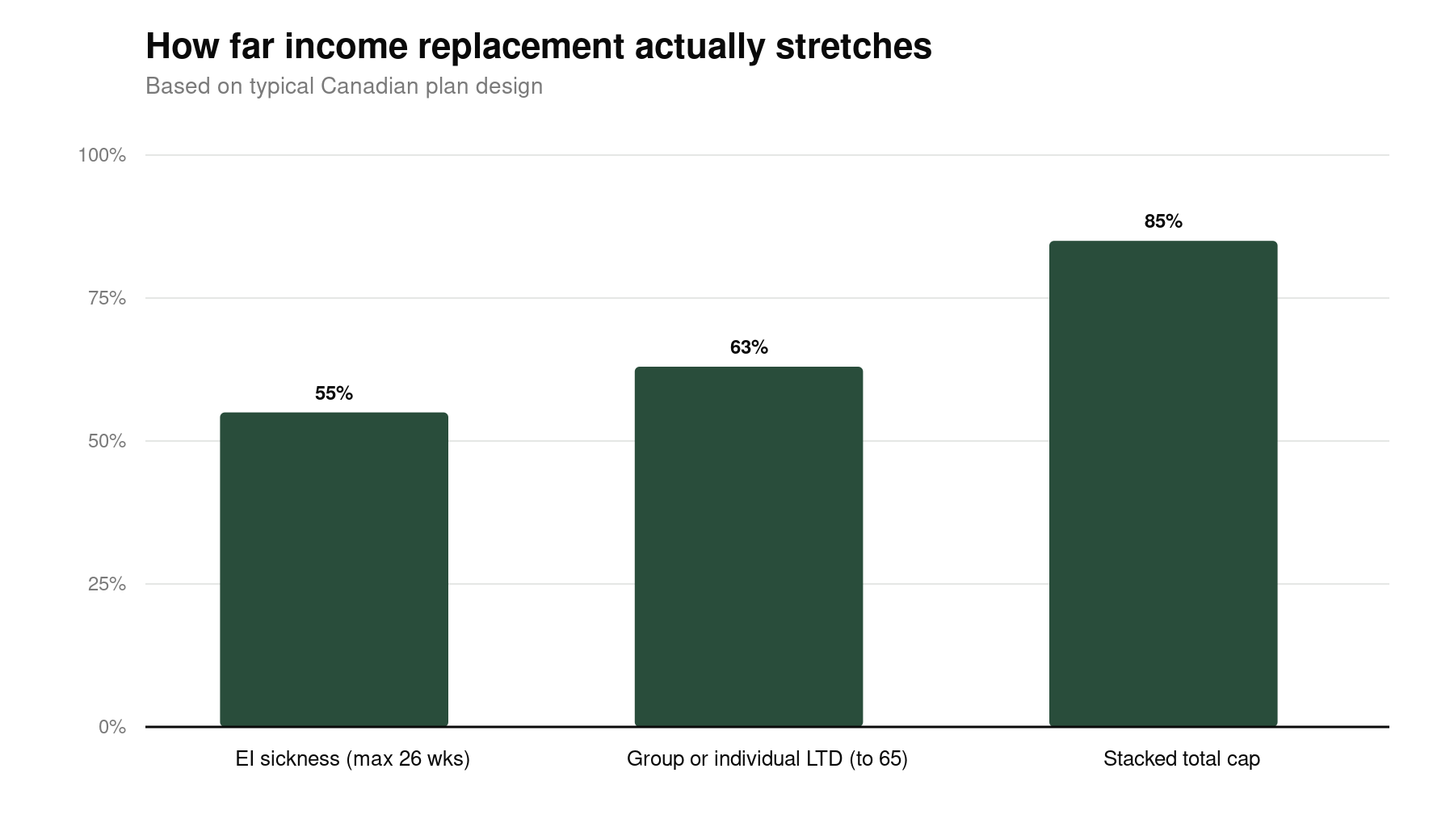
Government programs fill in around the edges. Employment Insurance sickness benefits pay 55 percent of average insurable earnings, up to a capped weekly maximum, for up to 26 weeks, and only to workers who've logged at least 600 insurable hours in the prior year and suffered at least a 40 percent income drop. Canada Pension Plan (or Quebec Pension Plan) disability benefits are a different animal entirely, reserved for a disability considered both "severe," meaning it prevents you from working in any capacity, and "prolonged," meaning it's expected to be long-term or permanent, converting automatically to a retirement pension at 65. Workers' Compensation applies only to injuries or illnesses that arose on the job.
Business-use disability products exist for owners and incorporated professionals specifically: business overhead expense insurance to keep the lights on and staff paid while the owner recovers, disability buyout coverage to fund a partner buyout under a buy-sell agreement, and key person coverage to protect the business against the loss of an employee whose contribution is hard to replace. These protect the business, not the owner's personal income, and they're a separate conversation from everything above.
Group versus individual: what actually differs
| Individual policy | Group policy | Creditor (mortgage) insurance | |
|---|---|---|---|
| Policyholder | You | Your employer or association | The lending institution |
| Underwriting | Full medical and financial | Little to none for base coverage | Limited or none at application |
| Definition of disability | Your choice: own occupation, regular occupation, or any occupation | Usually shifts from own/regular occupation to any occupation over time | Total disability only |
| Premium level | Highest, based on your own risk profile | Lowest, based on the group as a whole | Moderate to high |
| Portability | Fully portable | Ends if you leave the employer or group | Tied to the specific loan |
| Flexibility | High, customizable at issue | Limited to plan design | None |
Why "I have coverage at work" is rarely the whole answer
Group coverage is valuable, and for most salaried employees it does real work in the background. But three structural features of group plans routinely leave gaps that people don't discover until they need the coverage. First, benefits are capped, both as a percentage of salary and as an overall dollar maximum, and higher earners in smaller groups are the most likely to find that cap sitting well below what a real income-replacement calculation says they need. Second, the definition of disability in most group long-term plans shifts from an own- or regular-occupation standard to a stricter any-occupation standard after roughly one to two years on claim, a detail that catches people off guard mid-claim rather than at enrolment.
Third, and most overlooked, group coverage isn't yours. It belongs to the plan sponsor, and it disappears the day you leave the job, get laid off, or your employer changes providers and redesigns the benefit. A 35-year-old between jobs for three months has, for that stretch, exactly the disability coverage a self-employed person has: none, unless they've also built an individual policy underneath the group plan as a permanent floor.
Self-employed and incorporated: the group without a group
By 2023, self-employed workers made up over 13 percent of the Canadian workforce, and for this group, the "employer" providing a benefits plan simply doesn't exist. Some insurers have adapted with non-traditional disability products built for this reality: policies that separate accident-only coverage from sickness coverage so contract workers can buy cheaper, first-day-benefit protection against injury specifically; income-based definitions of disability rather than duty-based ones, since a contractor's work varies engagement to engagement; and, in a few cases, limited coverage for people who don't currently have a signed contract, defined as an inability to seek new work due to disability rather than an inability to perform a specific job.
Consider a hypothetical self-employed marketing consultant who assumes that, because she has paid into Employment Insurance for years through her sole proprietorship, she would be covered if she got sick. Opting into EI special benefits for the self-employed has to happen before you're already ill, requires paying both the employee and employer portions of the premium yourself, and isn't retroactive, so she would find the gap only when she tried to file a claim. The fix for self-employed and incorporated professionals is almost always the same: an individually underwritten policy, sized to real income, bought while healthy, rather than relying on government programs designed with employees in mind.
The definitions doing the real work behind every payout
Whichever source of coverage you're looking at, the definition of disability in the contract decides more than almost anything else. "Own occupation" lets you collect the full benefit even if you go on to earn income doing something else entirely. "Regular occupation" works the same way but reduces or stops the benefit if you choose to return to any kind of work. "Any occupation," the strictest standard, requires that you be unable to perform any job reasonably suited to your training and experience, not just your former one.
Government disability programs like CPP and QPP use an even stricter bar again: total, permanent inability to work in any capacity. These distinctions matter enough that they deserve their own deep dive, which we cover in full in our long-term disability insurance guide.
How much of your income can actually be replaced
Insurers cap disability benefits below 100 percent of income by design, usually in the 60 to 66.66 percent range for tax-free individual and long-term group coverage, or 70 to 75 percent for taxable short-term coverage, specifically so there's no financial incentive to stay on claim longer than necessary. When multiple sources stack, a group plan plus an individual top-up, for instance, most contracts cap the combined total at around 85 percent of pre-disability income, with the group plan typically paying first and the individual policy filling the remainder.
This is exactly why a proper accounting of what you already have, rather than an assumption, matters before adding anything new: it's just as possible to be needlessly over-insured and paying for coverage you can never actually collect on as it is to be under-insured.
It’s just as possible to be needlessly over-insured, paying for coverage you can never actually collect on, as it is to be under-insured.
The verdict: map it before you buy anything
A common gap isn't a total absence of coverage. It's a mismatch between what someone assumes their group plan or government entitlements cover and what the actual numbers say. Start by listing every source you currently have, group benefits booklet in hand, mortgage paperwork in hand, and add up the real replacement percentage and dollar cap each one provides. Compare that total to 60 to 85 percent of your actual income. Whatever's missing, whether that's a portable individual policy underneath a job-dependent group plan, coverage to bridge the gap while self-employed, or business overhead protection layered on top of personal coverage, is the one thing worth fixing first.
That's the whole job of a gap review: not selling a policy, just finishing the math nobody's done yet. The fastest way to find out is a free Gap Assessment, a two-minute look at the size of your gap with no meeting required. If you are ready for the full picture, book a Gap Review and we will map it against your real numbers.
Frequently asked questions
What are the main types of disability insurance in Canada? Five main sources exist: individually owned policies, employer or association group plans, creditor (mortgage or loan) insurance, government programs like EI sickness benefits and CPP/QPP disability, and, for business owners, specialized products like business overhead expense and disability buyout insurance.
Does EI cover long-term disability? No. EI sickness benefits pay 55% of average insurable earnings, up to a capped maximum, for a maximum of 26 weeks, which covers only the earlier phase of a disability. Longer-term protection has to come from group or individual disability insurance.
Can self-employed people get disability insurance in Canada? Yes, through an individually underwritten policy sized to income, or through non-traditional plans some insurers design specifically for contract and self-employed workers. Self-employed workers can also opt into EI special benefits, but only by registering in advance, since the option isn't retroactive once a claim arises.
What's the difference between group and individual disability insurance? Group coverage requires little medical underwriting, is priced on the group as a whole, and ends when you leave the employer or association. Individual coverage is fully underwritten to you personally, is fully portable, and lets you choose your own definition of disability, waiting period, and benefit period.
How much of my income does disability insurance replace? Typically 60 to 66.66% for tax-free long-term coverage, or 70 to 75% for taxable short-term coverage. When multiple sources of coverage overlap, most contracts cap the combined total at around 85% of pre-disability income.
Disclaimer
This article is general information for Canadian consumers, based on LLQP curriculum and public regulatory material. It is not financial, tax, or legal advice, and nothing here is a quote or guarantee. Any dollar figures, charts, or client scenarios used as examples in this article are hypothetical illustrations only, not based on real clients, and not tied to any specific insurer or product. Speak with a licensed advisor about your own situation.
About your advisor
Brenda Nkwocha and Hilda Chukwu are licensed life insurance advisors in Ontario. They lead with your gap, not a product: a straight look at what you actually have and what you actually need, explained in plain language before anything is recommended. This article is for educational purposes only and isn’t a quote, an offer, or personalized advice.
Two minutes now beats a guess you can’t take back.
See the size of your gap, then decide what to do with it.