Whole Life Insurance in Canada: What You’re Actually Buying, and Whether You Need It


Educational content. Examples are hypothetical.
Most people researching whole life insurance have already heard the pitch about building tax-sheltered cash value inside a policy, sometimes framed as "being your own bank." Before that conversation goes any further, it helps to ask what problem you're actually trying to solve, because whole life insurance is a permanent policy that guarantees your premium, your death benefit, and a minimum cash surrender value for the rest of your life, and that combination of guarantees is valuable for some people and the wrong first purchase for most families.
The strategy narrative and the underlying product are two different things, and conflating them is how people end up overpaying for coverage they didn't need or underinsured for the risk they actually had.
The strategy narrative and the underlying product are two different things, and conflating them is how people end up overpaying for coverage they didn’t need.
How a whole life policy is built
A whole life contract works by charging you more than the pure cost of insuring your life in the early years, and less than that cost in the later years, once mortality risk has risen well past what a level premium alone would cover. That overpayment in the early years builds a policy reserve, which the insurer invests, and which is the source of the cash surrender value you can access if you ever surrender the policy.
Because the insurer is setting premiums based on decades of mortality, expense, and investment assumptions, those assumptions are conservative, which is part of why whole life premiums are meaningfully higher than term premiums for the same coverage amount at any given age. You're not just paying for insurance protection, you're pre-funding decades of it up front.
Whole life policies come in two flavours worth knowing apart. A non-participating policy has a fixed premium and death benefit with no possibility of dividends. A participating policy may pay you a share of the insurer's surplus as a dividend if mortality, expenses, and investment returns come in better than the conservative assumptions built into your premium, though that dividend is never guaranteed and depends on the insurer's actual experience, not a promised rate of return.
Dividends can be taken in cash, used to reduce your premium, left to accumulate, or used to buy small amounts of additional paid-up coverage that require no new medical evidence, which is one of the more useful features of a participating policy over time.
What the guarantee actually costs you
Here's the tradeoff in plain terms. Early in a policy, whole life premiums are higher than term premiums for identical coverage, because you're building that reserve. Later in life, the relationship flips: term premiums for someone in their sixties or seventies become extremely expensive, or unavailable altogether past a certain age, while whole life premiums remain level for the life of the policy. So the real comparison isn't "which is cheaper," it's "which matches how long you actually need the coverage to last." If your need has a known end date, mortgage payoff, kids finishing school, a business loan retiring, term is almost always the cheaper way to cover it.
If your need has no end date, an estate tax bill that will exist no matter when you die, a permanent legacy gift, funding a buy-sell agreement that could trigger at any age, whole life or term-100 does something term structurally cannot.
Who actually needs permanent coverage, and who's being sold a want
The marketing around whole life insurance in Canada leans hard on the cash-value and tax-sheltered growth angle, sometimes dressed up as "infinite banking" or "being your own bank." Strip away the branding and what you're left with is a mechanism: a policy that builds cash value you can borrow against, inside a legal structure that shelters growth from tax within certain limits. That mechanism is real. Whether it's the right tool for you depends entirely on what you actually need the insurance to do, not on how compelling the strategy sounds in a seminar.
For most families and most professionals, the first and most urgent need is straightforward income replacement if a primary earner dies while the mortgage, the kids, or a spouse's reduced income still depend on that income. Term insurance, sized to that need and priced for the years it actually needs to last, does that job at a fraction of the cost of whole life, which frees up cash flow for the things families are usually more underinsured on anyway, particularly disability coverage.
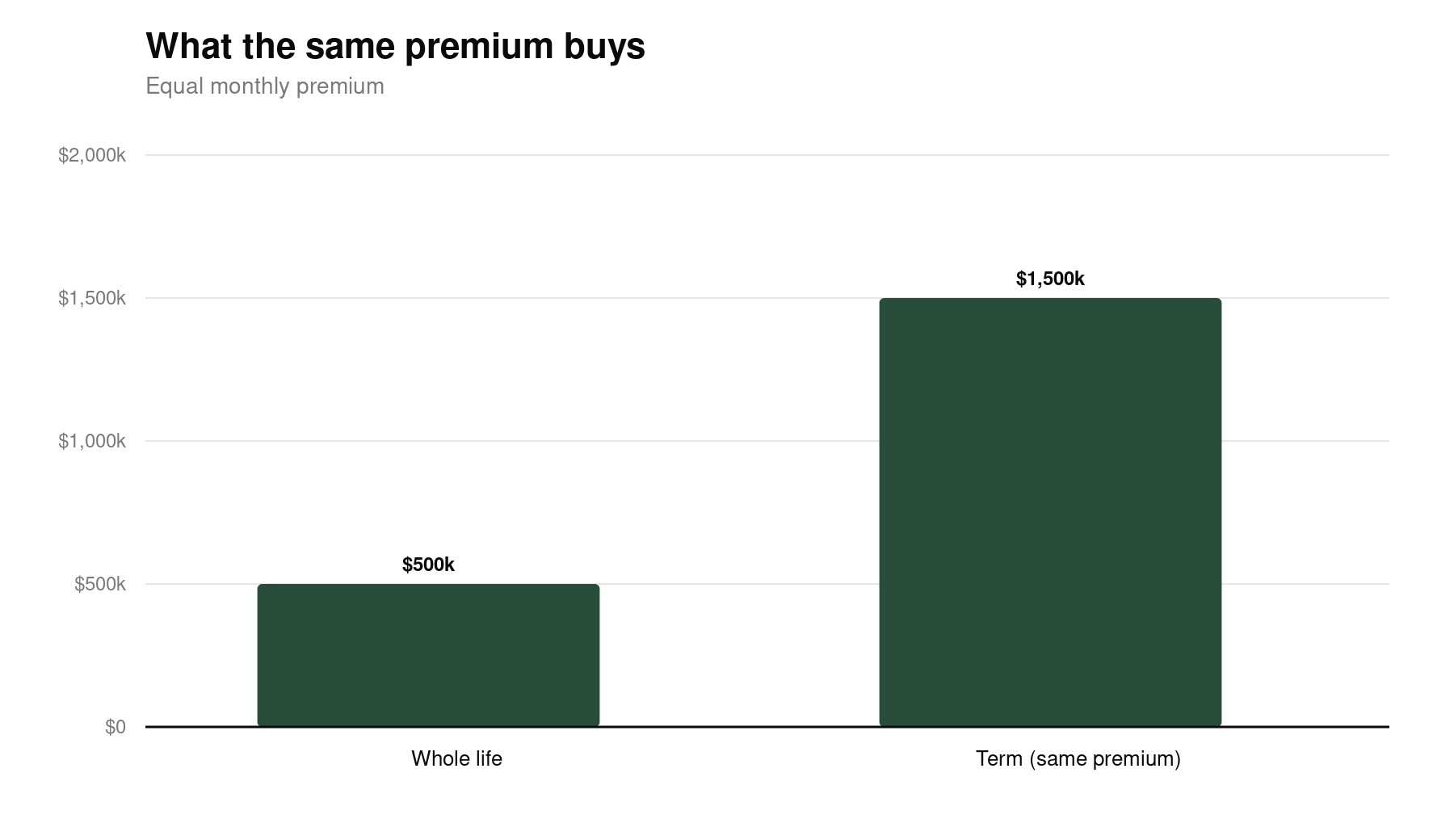
Consider a hypothetical family that wants $500,000 of whole life. The same premium can often buy much more term coverage and leave room for education savings, so it is worth running the numbers on your own case before deciding.
Where whole life earns its premium is different territory. A client who owns a cottage or a business expected to appreciate significantly and wants to make sure the eventual capital gains tax bill at death doesn't force a fire sale of that asset has a need with no expiry date, and permanent insurance is the only structurally correct answer, since no term policy will still be in force whenever that death eventually occurs. Someone building a specific, guaranteed legacy gift to a person or a charity has the same profile.
A parent buying a small permanent policy on a child locks in that child's future insurability regardless of what health issues might emerge later, which is a distinct and legitimate use case that has nothing to do with cash-value accumulation. And business owners using corporate-owned permanent insurance to fund a buy-sell agreement or manage retained earnings inside a corporation are solving a problem that, again, doesn't have a natural end date.
Term life insurance vs. whole life insurance in Canada
| Term life insurance | Whole life insurance | |
|---|---|---|
| Duration | Fixed term (10, 20, 30 years, or to a specified age) | Entire lifetime, no expiry |
| Premiums | Lower initially; increase sharply at renewal or with age; unavailable past roughly 75-80 | Higher initially; level for life once issued |
| Cash value | None; policy has no value at expiry | Builds a cash surrender value over time |
| Dividends | None | Available on participating policies, not guaranteed |
| Best suited for | Needs with a known end date: mortgage, income replacement while dependents are young, business loans | Needs with no end date: estate tax liquidity, legacy gifts, juvenile future insurability, corporate strategies |
Frequently asked questions
Is whole life insurance a good investment? It isn't structured as an investment first. It's permanent insurance protection that happens to build cash value as a byproduct of level, pre-funded premiums. The guarantees and any dividends should be evaluated against what you need the death benefit to do, not compared directly to market investment returns.
What happens if I stop paying premiums on a whole life policy? Depending on how much cash surrender value has built up, you typically have options: an automatic premium loan to cover a missed payment, converting to a reduced amount of fully paid-up coverage, or extending your existing coverage amount as term insurance for a period the cash value can support.
Can I borrow against my whole life policy? Yes. Most whole life policies allow a policy loan of up to roughly 90% of the cash surrender value, charged interest at the insurer's current rate. Any outstanding loan and interest reduces the death benefit if you die, or the surrender value if you cash out, before it's repaid.
Is "infinite banking" something Brenda & Hilda offers? No. It's a marketing label applied to using a participating whole life policy's cash value as a source of loans. The underlying mechanism, policy loans against cash surrender value, is a standard whole life feature, and whether it makes sense for you depends on your full financial picture, not on the branding.
Do I need whole life insurance if I already have term coverage? Not automatically. Many people are well served by term alone, or by a smaller permanent policy layered on top of a larger term policy to cover a specific lifetime need like estate liquidity or a legacy gift. The right mix depends on what each dollar of coverage is actually meant to do.
Is whole life insurance right for you?
The honest answer is suitability-dependent, and the only way to know which side of that line you're on is to look at your full picture: what you need covered, for how long, and what else that premium could be doing for you. That's exactly what a gap review is for. The fastest way to find out is a free Gap Assessment, a two-minute look at the size of your gap with no meeting required. If you are ready for the full picture, book a Gap Review and we will map it against your real numbers.
Disclaimer
This article is general information for Canadian consumers, based on LLQP curriculum and public regulatory material. It is not financial, tax, or legal advice, and nothing here is a quote or guarantee. Any dollar figures, charts, or client scenarios used as examples in this article are hypothetical illustrations only, not based on real clients, and not tied to any specific insurer or product. Speak with a licensed advisor about your own situation.
About your advisor
Brenda Nkwocha and Hilda Chukwu are licensed life insurance advisors in Ontario. They lead with your gap, not a product: a straight look at what you actually have and what you actually need, explained in plain language before anything is recommended. This article is for educational purposes only and isn’t a quote, an offer, or personalized advice.
Two minutes now beats a guess you can’t take back.
See the size of your gap, then decide what to do with it.