Segregated Funds vs. Mutual Funds in Canada (2026): Why the Guarantee Is the Real Difference


Educational content. Examples are hypothetical.
Almost everyone who asks about segregated funds leads with the same word. Guarantee. They have heard the product protects their money, and in a market that can fall twenty percent in a month, protection sounds like exactly what they want. The problem is that the guarantee rarely works the way people picture it, and the fee you pay for it is real whether or not you ever collect. So before you decide on segregated funds vs mutual funds, it is worth understanding what that guarantee actually promises, what it costs you every year, and whether your situation is one where it earns its keep.
Same investments, different wrapper
Both products start in the same place. A segregated fund and a mutual fund each pool your money with other investors and hand it to a professional manager who invests toward a stated objective, whether that is growth, income, or a balance of the two. On the inside, two funds chasing the same objective can hold nearly identical assets. The difference is not what sits in the fund. It is the legal wrapper around it, and that wrapper decides everything else.
A mutual fund is a security. You buy units through a dealer regulated by the Canadian Investment Regulatory Organization (CIRO). If the fund grows you have more, if it falls you have less, and that is the whole arrangement. A segregated fund is an insurance contract, technically an individual variable insurance contract, sold by a licensed life insurance agent. Because it is insurance, it can carry promises a security legally cannot: a guarantee on your money at certain moments, a payout that skips your estate, and in some cases a shield from creditors. Everything a segregated fund does that a mutual fund cannot traces back to that single fact. So does everything it costs.
Segregated funds vs mutual funds, side by side
| Feature | Segregated funds | Mutual funds |
|---|---|---|
| Legal structure | Individual variable insurance contract | Security (fund units) |
| Sold by | Licensed life insurance agent | Mutual fund dealer representative |
| Maturity guarantee | Yes, typically 75% or 100% of deposits, on a set maturity date | None |
| Death benefit guarantee | Yes, typically 75% or 100% of deposits, payable any time during the contract | None |
| Reset feature | Available on some contracts, locks in market gains and resets the maturity date | Not applicable |
| Bypasses probate | Yes, when a beneficiary other than the estate is named | No, proceeds go through the estate |
| Potential creditor protection | Yes, with an appropriate beneficiary designation (exceptions apply) | No |
| Insolvency protection | Assuris (protects against the insurer's failure) | CIPF (protects against the dealer's failure) |
| Typical fees (MER) | Higher, includes the cost of the guarantee reserve | Lower |
| Tax reporting | Insurer tracks the adjusted cost base (ACB) for you | Investor tracks ACB |
| Disclosure document | Information folder plus Fund Facts | Fund Facts |
| Right to cancel | Right of rescission, typically 2 business days from confirmation | Standard securities cancellation rules |
What the guarantee protects, and when
Yes, the guarantees protect your money. But they do it at only two moments, and this is the single most misunderstood thing about the product. The guarantee is not a floor under your account value every day of the year. It is a promise that applies on the contract’s maturity date, and on the date the life insured dies. That is it. For people within five or ten years of their target retirement date, this is almost always the first thing that needs clearing up.
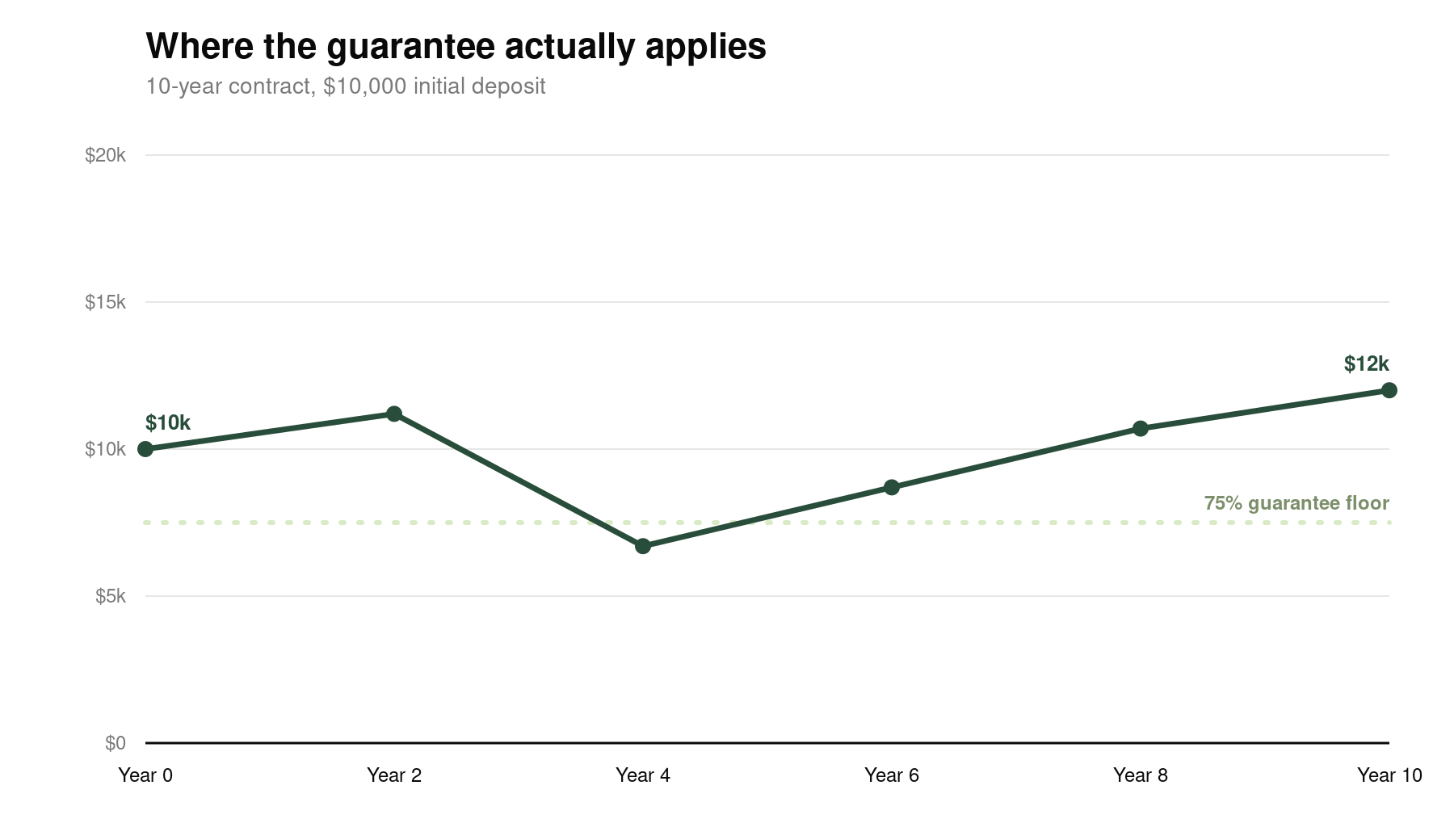
Picture a simple case: Marion puts $10,000 into a contract with a 75% maturity guarantee and a 75% death benefit guarantee, so each promise is worth $7,500. If her contract is worth $12,000 when it matures, she takes the $12,000 and the guarantee never enters the picture, because the market did better than the floor. If a downturn has dragged the contract down to $6,500 at maturity, the insurer tops her back up to $7,500.
But if Marion needs that money early, in the middle of a bad market and before the maturity date, she gets what the contract is worth that day. Not the floor. The guarantee helps her only if she holds to maturity or dies holding the contract. For money she has to pull out early, it does nothing.
The guarantee helps her only if she holds to maturity or dies holding the contract. For money she has to pull out early, it does nothing.
Some contracts add a reset, and it is worth understanding rather than fearing. If your contract has grown, a reset lets you lock that higher value in as your new guaranteed floor. The catch is that resetting usually pushes your maturity date further out, so you are trading a higher guarantee for a longer wait to reach it. For someone who wants to bank a good run in the market, that can be exactly right. For someone on a fixed timeline, it can quietly move the goalposts. Use it on purpose, not by default.
What the guarantee costs you
What you give up for all of this is cost, and it is not trivial. The management expense ratio on a segregated fund runs higher than on a comparable mutual fund, because part of it funds the reserve that backs the maturity and death benefit guarantees. You pay it every year, in good markets and bad.
Here’s the arithmetic: if a fund’s underlying investments gain five percent in a year and the MER is three percent, your reported return is two percent. If those same investments lose five percent and the MER is still three percent, you are down eight percent after fees. In any single year that is a nuisance. Over a decade or two, a persistently higher fee is a measurable drag on what you keep. It is not a rounding error. It is the price of the guarantee, and you should know you are paying it.
One cost that used to lurk in both products has largely been legislated away. The deferred sales charge, the penalty for pulling your money out too soon, can no longer be attached to new segregated fund contracts as of June 1, 2023, part of a national move by insurance regulators. Mutual funds phased theirs out the year before. If you are looking at an older contract, check whether a DSC schedule still applies before you move anything, because that one can still bite.
Who needs the guarantee, and who is paying for nothing
Most people who ask about segregated funds have heard the word guarantee and decided they want one, without asking what it guarantees, for how long, and at what price. Wanting the guarantee is human. Whether you need it is a different question, and the honest answer comes down to three situations.
The first is timing. If you are close enough to the date you will start drawing this money that a market drop right beforehand would damage your plan, the maturity guarantee gives you a floor at a date you control. That is real protection for someone five or ten years from retirement, and close to meaningless for someone with thirty years to ride out the market.
The second is your estate. Naming a beneficiary other than your estate lets the money pay out directly to that person and skip probate, which in most provinces means skipping the probate fee on that amount. If keeping your estate simple and private matters to you, that bypass has value a mutual fund generally cannot match.
The third is creditor exposure. For a business owner or a professional carrying liability, a segregated fund with the right beneficiary designation can add a layer of protection from creditors, at death and in some cases while you are alive. There are exceptions, it is not absolute, and nobody should buy a segregated fund for creditor protection without a lawyer and a tax advisor confirming it works for their specific situation. It is a reason to look, not a reason to assume.
If none of those three fit, if you are investing for growth over a long horizon with no near-term withdrawal, no probate worry, and no creditor exposure, the guarantee is a cost without a job. A lower-fee mutual fund, or another low-cost option, usually does the same growth work for less. That is not a knock on segregated funds. It is suitability. The product is excellent for the person who needs what it does, and expensive for the person who does not.
The guarantee is a cost without a job for the wrong buyer. The product is excellent for the person who needs what it does, and expensive for the person who does not.
Two situations come up often enough to name. If you are within five to ten years of drawing this money down and you want to protect gains you have already made, do not stop at “guaranteed sounds good.” Ask exactly what the reset feature does and what it does to your maturity date, because that detail is where the real decision lives. And if you have just come into a lump sum, an inheritance, a business sale, an insurance payout, and you are not ready to decide anything, the right first move usually is not locking it into any product, guaranteed or not.
It is parking it somewhere safe while you get a proper structure review done. Sometimes the answer is a segregated fund, sometimes an annuity, sometimes neither. You will not know until you look at the whole picture.
One more practical difference people underrate is the paperwork. In a non-registered account, the two products are taxed much the same way. Both pass interest, dividends, and capital gains through to you, and both let you carry a capital loss back three years or forward indefinitely to offset gains. The quiet advantage of a segregated fund is that the insurer tracks your adjusted cost base for you, which prevents a lot of reporting errors. With a mutual fund, that tracking falls to you or your platform.
How to decide
Do not start with the product. Start with your own timeline and your estate. Ask when you truly need this money and whether a guarantee at that date protects something real. Ask whether avoiding probate matters to your plan. Ask whether you carry creditor exposure you are honestly trying to manage. And ask whether you are comfortable paying a higher fee every year for protection you might never use. If you answered yes to any of the first three, a segregated fund earns a serious look. If it is no across the board, the higher fee is probably buying you very little.
Either way, this decision does not belong in isolation. Whether a segregated fund fits depends on how it sits next to your income timeline, your other accounts, and your estate, which is the entire point of a Retirement Structure Review. It is not a product pitch. It is a clear look at where the gaps actually are before anyone talks about filling them. The fastest way to find out is a free Gap Assessment, a two-minute look at the size of your gap with no meeting required. If you are ready for the full picture, book a Gap Review and we will map it against your real numbers.
Frequently asked questions
Are segregated funds worth the higher fees? It depends on whether you will use the guarantee, the probate bypass, or the creditor protection. If none of those apply to your situation, a lower-fee mutual fund usually delivers similar growth for less. If they do apply, the fee is buying something real.
What happens to my segregated fund if the market drops right before I need the money? The guarantee applies at the contract’s maturity date or on death. If you withdraw early during a downturn, you receive the market value that day, not the guaranteed amount.
Do segregated funds always avoid probate? Only when you have named a beneficiary other than your estate. Quebec and Manitoba do not charge probate fees on any vehicle, so the bypass adds nothing there. Every other province and territory does.
Can I lose money in a segregated fund? Yes, before the maturity date or death. The guarantee protects the amount set in your contract only if you hold to maturity or the life insured dies. Early withdrawals are valued at the market price that day.
Are mutual funds and segregated funds taxed the same way? Largely, in a non-registered account. Both pass interest, dividends, and capital gains through to you, and both let capital losses offset gains. The main difference is that a segregated fund’s insurer tracks your adjusted cost base for you, while a mutual fund investor handles that tracking themselves.
Disclaimer
This article is general information for Canadian consumers, based on LLQP curriculum and public regulatory material. It is not financial, tax, or legal advice, and nothing here is a quote or guarantee. Any dollar figures, charts, or client scenarios used as examples in this article are hypothetical illustrations only, not based on real clients, and not tied to any specific insurer or product. Speak with a licensed advisor about your own situation.
About your advisor
Brenda Nkwocha and Hilda Chukwu are licensed life insurance advisors in Ontario. They lead with your gap, not a product: a straight look at what you actually have and what you actually need, explained in plain language before anything is recommended. This article is for educational purposes only and isn’t a quote, an offer, or personalized advice.
Two minutes now beats a guess you can’t take back.
See the size of your gap, then decide what to do with it.