TFSA vs RRSP vs FHSA for Canadians


Educational content. Examples are hypothetical.
Almost everyone eventually asks some version of the same question: should this money go into a TFSA, an RRSP, or, more recently, an FHSA? All three shelter your savings from tax in some way, and all three get lumped together as “registered accounts,” but they are built for different jobs. Using the right one at the right time can change how much of your own money you keep. Using the wrong one isn’t a disaster, but it usually means paying more tax than you had to, or tying up money in a way that doesn’t fit what you actually needed it for.
TFSA vs RRSP vs FHSA: three very different tools
Every one of these accounts exists to shelter your savings from tax in some way. The differences show up in when you get the tax break, whether growth is taxed at all, and what the money is actually meant to be used for. Here is the side-by-side version before we get into each one individually.
| TFSA | RRSP | FHSA | |
|---|---|---|---|
| Tax deduction on contribution | No | Yes | Yes |
| Tax on investment growth | None, ever | Deferred until withdrawal | None, on a qualifying withdrawal |
| Tax on withdrawal | None | Taxed as regular income | None, if used for a qualifying first home purchase |
| Primary purpose | General flexible savings | Retirement income | A first home, specifically |
| Withdrawn room | Added back the following calendar year | Does not come back once withdrawn (outside HBP/LLP) | Does not come back once withdrawn |
| Time limit on the account | None | Must convert to a RRIF by age 71 | 15 years, age 71, or the year after a qualifying withdrawal |
The exact annual contribution limits for the TFSA and RRSP are indexed and adjusted most years, so treat any specific dollar figure below as a snapshot rather than this year’s number, and confirm the current limit on canada.ca before you rely on it for your own planning.
How the TFSA actually works
A TFSA is the most flexible of the three, and the mechanics are the easiest to explain. You contribute after-tax money, so there is no deduction the year you put money in. In exchange, everything the account earns, interest, dividends, capital gains, comes out completely tax-free, whenever you take it out, for any reason.
Contribution room starts accumulating the year you turn 18, whether or not you actually open an account, and any room you don’t use carries forward indefinitely. The feature that catches people off guard is what happens after a withdrawal: the amount you take out is added back to your contribution room, but not until January 1 of the following calendar year. Withdraw $5,000 in June and re-contribute it in July of the same year, and you may have just over-contributed, which the CRA penalizes at 1% per month on the excess amount.
Because there is no penalty for taking money out and no tax consequence either way, a TFSA is usually the right home for an emergency fund, short-to-medium-term savings, or any goal where you might need the money before retirement and don’t want a tax bill attached to touching it.
How the RRSP actually works
An RRSP works on the opposite principle. You get a tax deduction the year you contribute, which lowers your taxable income for that year, and the account grows tax-deferred, not tax-free. Every dollar you eventually withdraw, contributions and growth alike, is taxed as regular income in the year you take it out.
Contribution room is based on 18% of your previous year’s earned income, up to an annual dollar maximum that is indexed and adjusts most years, plus any unused room carried forward from prior years. Unlike a TFSA, that room does not regenerate when you withdraw. Take $10,000 out of an RRSP outside of the two special programs below, and that $10,000 of contribution room is gone permanently, on top of the tax you’ll owe on it.
The RRSP earns its keep on the gap between your tax rate today and your tax rate in retirement. Contribute while you’re in a higher tax bracket, withdraw later in a lower one, and the deduction you got today is worth more than the tax you’ll eventually pay. Contribute while you’re in a low bracket and withdraw later in a higher one, and the math can work against you. This is exactly the kind of comparison a proper needs analysis walks through with your actual numbers, not a rule of thumb.
Two features are worth knowing by name. The Home Buyers’ Plan (HBP) lets a first-time buyer withdraw from an RRSP toward a home purchase without immediate tax, as long as it’s repaid to the RRSP over 15 years; any year you don’t repay the required amount, that portion is added to your taxable income instead. The Lifelong Learning Plan (LLP) works similarly for funding full-time education. Both are loans from your own retirement savings, not free money. An RRSP must also be converted to a RRIF, or used to buy an annuity, by the end of the year you turn 71, after which minimum annual withdrawals are required and taxed.
The FHSA: built specifically for a first home
The First Home Savings Account is the newest of the three, and it’s the only one that combines the advantages of the other two instead of trading one off against the other. Contributions are tax-deductible, the same as an RRSP. A qualifying withdrawal toward a first home, principal and growth alike, is completely tax-free, the same as a TFSA. There is no other registered account in Canada that offers both at once, and it exists for exactly one purpose.
The annual contribution limit is $8,000, with a $40,000 lifetime maximum, both fixed by legislation rather than adjusted for inflation. Unused room carries forward by up to one year’s worth, so if you didn’t contribute last year, you could put in as much as $16,000 in a single year.
The account has to be used within 15 years of opening it, by the end of the year you turn 71, or by the end of the year following your first qualifying withdrawal, whichever comes first. To open one, you need to be a Canadian resident who hasn’t owned a home you lived in as a principal residence in the current calendar year or the four preceding ones, which is the CRA’s definition of a first-time buyer for this purpose.
The detail most people miss: an FHSA and a Home Buyers’ Plan withdrawal can both be used toward the very same home purchase. They are not either-or.
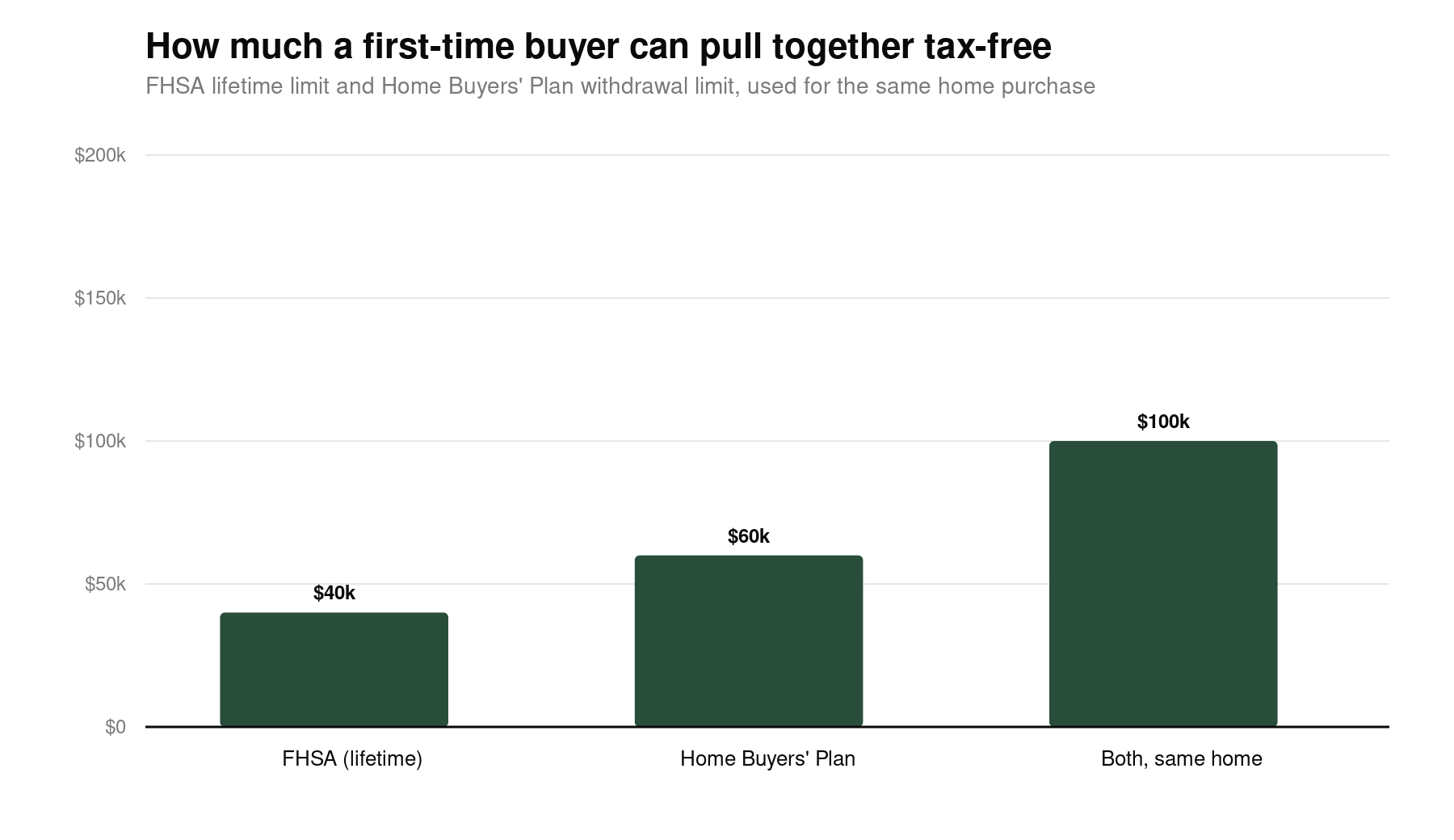
The FHSA is the only registered account in Canada where the contribution is deductible and the withdrawal is tax-free, for one specific purpose. Nothing else in the system offers both at once.
So which one should you use first?
There isn’t a single right order for TFSA vs RRSP vs FHSA, but there is a sensible way to think about it. If buying a first home is realistically on the horizon, the FHSA usually comes first, since it’s the only account that gives you a deduction now and a tax-free withdrawal later for that specific goal. If you’re not buying a home, or you’ve already used up your FHSA room, the choice comes down to your tax bracket today versus your expected bracket in retirement, and how much flexibility you want to keep. A TFSA never penalizes you for needing the money early. An RRSP does, outside the HBP and LLP.
Take a couple saving for their first home while also earning solidly enough that RRSP deductions help at tax time. Splitting new savings between an FHSA (for the home, with the tax deduction now) and an RRSP (for the deduction, with the option to also use the HBP toward the same home later) typically outperforms putting everything into a TFSA, precisely because it captures deductions the TFSA never offers.
A single parent building an emergency fund with no home purchase in sight is usually better off in a TFSA, where a withdrawal in a bad month costs nothing. Neither answer is universal; both come from matching the account to the actual goal, not from a general rule about which account is “best.”
What people usually get wrong
Assuming RRSP withdrawals are tax-free like a TFSA. They are not. Every dollar withdrawn from an RRSP, outside the HBP and LLP, is added to your income and taxed in that year, which can be a rough surprise for someone who treats it like a second TFSA.
Re-contributing to a TFSA in the same calendar year as a withdrawal. The room doesn’t come back until January 1 of the following year. Doing this by accident is one of the more common ways people trigger a CRA over-contribution penalty without realizing it.
Not realizing the FHSA and HBP can stack. Plenty of first-time buyers use only one, assuming they have to choose, and leave real tax-free room on the table for the exact same purchase.
Treating the RRSP deduction as automatically worth it. A deduction taken in a low-income year, then withdrawn in a higher-income year later, can leave you worse off than if the money had simply sat in a TFSA. The deduction is a timing tool, not a guaranteed win.
Forgetting the FHSA’s own clock. The 15-year window, the age-71 cutoff, and the one-year-after-a-qualifying-withdrawal rule all end the account’s tax-sheltered status. Money left in past that point loses the advantage that made the account worth opening.
Frequently asked questions
Can I have a TFSA, an RRSP, and an FHSA at the same time? Yes. There’s no rule against holding all three, and for many people, especially first-time buyers, using more than one at once is exactly how the accounts are meant to work together.
What happens to unused FHSA room if I never buy a home? You can transfer the funds to an RRSP or RRIF tax-free (within your available RRSP room, or without using any if the account is closed for this reason), or withdraw them, in which case the withdrawal is taxed as income, similar to an RRSP withdrawal.
Is it better to max out my TFSA or my RRSP first? It depends on your current tax bracket, your expected bracket in retirement, and whether you might need the money before then. There’s no single correct order for every household; it’s worth running the actual numbers rather than guessing.
Do I have to repay Home Buyers’ Plan withdrawals? Yes, over 15 years. Any year you don’t repay the required minimum, that amount is added to your taxable income for that year instead.
Can I use the FHSA for a second home? No. Eligibility requires that you haven’t owned a home you lived in as a principal residence in the current year or the four preceding calendar years, which is the CRA’s test for a first-time buyer.
The TFSA vs RRSP vs FHSA decision is really a question about your own income, timeline, and goals, which is exactly what a proper financial review is for. The fastest way to find out where you stand is a free Gap Assessment, a two-minute look at the size of your gap with no meeting required. If you’re ready to map your actual numbers against your options, book a Gap Review and we’ll go through it together.
Disclaimer
This article is general information for Canadian consumers, based on publicly available CRA guidance on the TFSA, RRSP, and FHSA. It is not financial, tax, or legal advice, and nothing here is a quote or guarantee. Contribution limits, dollar figures, and program rules are current as of publication and are adjusted periodically by the CRA; confirm the current-year figures on canada.ca before making a decision. Speak with a licensed advisor or accountant about your own situation.
Sources
- Canada Revenue Agency, Tax-Free Savings Account (TFSA), guidance and contribution room rules.
- Canada Revenue Agency, Registered Retirement Savings Plan (RRSP), contribution limits, Home Buyers’ Plan, and Lifelong Learning Plan.
- Canada Revenue Agency, First Home Savings Account (FHSA), eligibility, contribution limits, and qualifying withdrawal rules.
- Department of Finance Canada, Home Buyers’ Plan withdrawal limit increase (2024 federal budget).
About your advisor
Brenda Nkwocha and Hilda Chukwu are licensed life insurance advisors in Ontario. They lead with your gap, not a product: a straight look at what you actually have and what you actually need, explained in plain language before anything is recommended. This article is for educational purposes only and isn’t a quote, an offer, or personalized advice.
Two minutes now beats a guess you can’t take back.
See the size of your gap, then decide what to do with it.