Critical Illness Insurance in Canada (2026): How the Lump Sum Actually Works, and Why It Isn’t Disability or Life Insurance


Educational content. Examples are hypothetical.
A useful question about critical illness insurance isn't only "what does it cover," it's also "isn't that basically the same as my disability coverage, or an add-on to my life insurance?" It's neither, and the confusion is understandable because all three products sit in the same conversation. Critical illness insurance pays a tax-free lump sum, in one payment, the moment you're diagnosed with a covered condition such as a heart attack, stroke, or cancer, provided you survive a short waiting period after diagnosis, typically around 30 days.
The payout has nothing to do with whether you can still work and nothing to do with dying. That single fact, a living benefit paid on diagnosis rather than on death or on lost income, is what separates critical illness insurance from both life insurance and disability insurance, and it's worth understanding clearly before deciding whether your household actually needs a third product on top of the two you probably already have.
Critical illness insurance: what actually triggers the payout
Two timing rules govern every critical illness claim, and both exist to keep the product honest. The first is the qualification period: a condition first diagnosed or first showing symptoms within 30 days of the policy being issued generally isn't covered, which prevents someone from buying coverage the week they suspect something is wrong. The second is the survival, or waiting, period: after diagnosis, the insured has to survive a further stretch, usually 30 days, though some insurers extend it to 90 days for conditions like cancer or stroke specifically, because the whole design of the product is to pay people who live through a critical illness, not to function as a disguised death benefit.
If the insured survives that waiting period but dies before the claim is fully processed, the benefit is still paid, to the estate or a named beneficiary.
Once the diagnosis is confirmed and the waiting period passes, there's no restriction on what the money is used for. Clients use it to pay down a mortgage or credit card balance, to cover alternative treatments the provincial plan doesn't fund, to renovate a home for a wheelchair or reduced mobility, to take unpaid time off beyond what any income-replacement plan covers, or simply to keep the household running while everything else gets figured out. That flexibility is the actual product here. Nobody is auditing receipts.
The "Big 4," and how far coverage extends from there
Most critical illness policies, at a minimum, cover four conditions: heart attack, stroke, cancer, and coronary bypass surgery. These are sometimes sold as a standalone, lower-cost contract, but the more common products in the Canadian market extend to 10 or even 20-plus covered conditions, adding things like Alzheimer's disease, aortic surgery, aplastic anemia, bacterial meningitis, benign brain tumour, blindness, coma, deafness, kidney failure, loss of independent existence, loss of limbs, loss of speech, major organ failure or transplant, motor neuron disease, multiple sclerosis, occupational HIV infection, paralysis, Parkinson's disease, and severe burns.
Children's policies, sold separately, typically fold in conditions more associated with minors, like muscular dystrophy, type 1 diabetes, cerebral palsy, and cystic fibrosis. The exact list and the exact severity threshold for each condition varies by insurer and by the year the contract was issued, so two policies that both claim to cover "stroke" can define a qualifying stroke quite differently.
How this is different from disability insurance
The cleanest way to see the difference is to picture the same person going through the same heart attack under both products. Disability insurance replaces a percentage of income, but only for as long as the person is actually unable to work, and it stops once they return to their job, whatever the definition of disability in their contract requires. Critical illness insurance pays the full lump sum once, at diagnosis, and there's no clawback if the person makes a full recovery and is back at work within a month.
The two products can also diverge in the other direction: someone might be too disabled to work for a long stretch without ever having suffered a condition that meets a critical illness contract's specific definition, in which case disability benefits would apply but critical illness would not.
They aren't substitutes for each other. A household relying on strong disability coverage alone still has a real gap for the lump-sum expenses, home modifications, private treatment, a period of reduced hours rather than zero hours, that disability income alone was never built to absorb.
| Disability insurance | Critical illness insurance | Life insurance | |
|---|---|---|---|
| What triggers payment | Inability to work due to injury or illness | Diagnosis of a specifically defined covered condition | Death of the life insured |
| Form of benefit | Monthly income, for the benefit period | One lump sum (occasionally staged payments) | One lump sum |
| Tied to lost income? | Yes, benefit is a percentage of income | No, paid regardless of income loss | No |
| Paid if you fully recover and return to work? | No, benefit stops | Yes, in full, no clawback | Not applicable |
| Taxation of benefit | Depends who paid the premium (see disability insurance guide) | Tax-free | Generally tax-free |
How this is different from life insurance
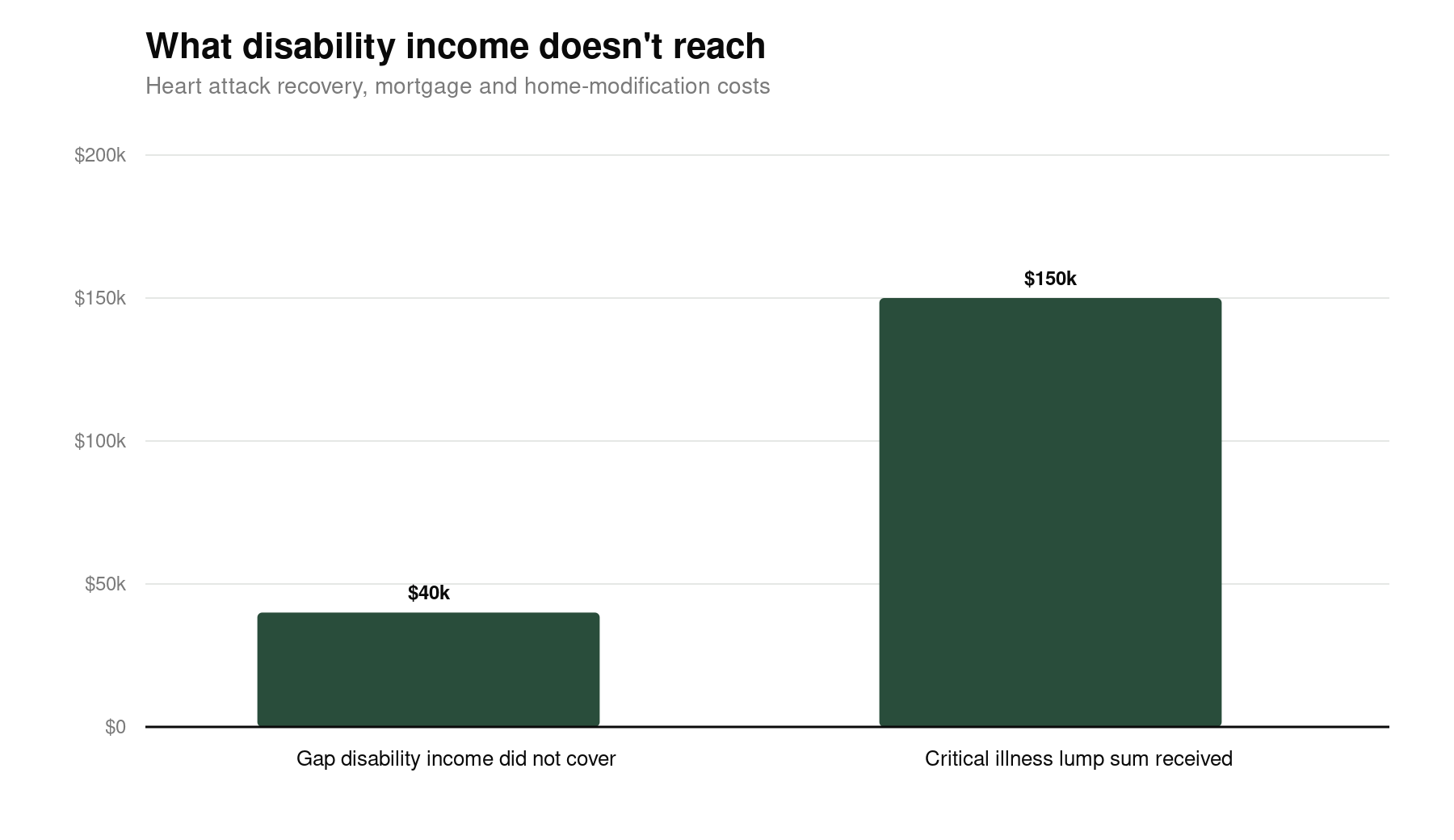
Life insurance protects the people who depend on your income after you're gone. Critical illness insurance protects your savings and your lifestyle while you're still here and dealing with the fallout of a serious diagnosis. Take a couple in their early forties with a mortgage and two kids, where the higher earner has a heart attack. He survives, and after eight weeks off work his disability coverage is replacing about 60 percent of his salary, which covers the basics but doesn't touch the $40,000 needed to finish paying down a line of credit and put a stairlift and a ground-floor bathroom into the house.
A $150,000 critical illness lump sum, arriving roughly a month after diagnosis, covers exactly that gap without the family touching retirement savings or a home equity line at a bad moment. Life insurance, in this scenario, never comes into play at all, because nobody died.
Life insurance is for the household that loses an income earner permanently. Critical illness insurance is for the household absorbing the cost of a serious illness that someone survives.
Where claims actually get denied
According to the Autorite des marches financiers, critical illness claim denials commonly trace back to a small handful of causes: exclusions or limitations in the contract, a pre-existing condition that wasn't disclosed or that falls inside the qualification window, the diagnosis not meeting the contract's precise definition of the covered condition, or the survival period not being satisfied. That distinction on definitions matters: your doctor's opinion that you've had a stroke doesn't automatically mean the insurer's contractual definition of a qualifying stroke has been met.
Contracts specify a degree of neurological impairment, a type of cancer, or a threshold of heart muscle damage, and those thresholds can differ from one insurer's policy to the next, and even between two policies from the same insurer issued in different years, as medical diagnostic standards evolve.
Riders worth knowing about
A return of premium (ROP) rider refunds some or all of the premiums paid if the policy expires with no claim ever filed, on death from an uncovered cause, on surrender after a set number of years, or at maturity; it typically adds a meaningful amount to the base premium, sometimes 25 to 50 percent more, so it's a suitability conversation of its own. A waiver of premium rider suspends premium payments during a period of total disability of the insured, a different, lower bar than a critical illness claim, so it's possible to have premiums waived under this rider for a condition that never triggers the critical illness benefit itself.
Some contracts also offer a second event rider, letting the policy survive a first successful claim so a later, unrelated diagnosis can still trigger a reduced payout, since most base contracts terminate automatically after paying out once.
What about a business owner with no overhead coverage?
This is worth naming directly for incorporated business owners: a small business owner who has never set up business overhead expense insurance is exposed twice over during a critical illness, once personally and once through the business, because rent, staff salaries, and supplier payments don't pause for a diagnosis. A critical illness lump sum, paid to the individual, can function as an informal bridge for both exposures at once in a way a disability claim, which is capped and paid monthly, often can't move fast enough to cover.
It isn't a substitute for proper business continuity planning, but for an owner who hasn't gotten around to that yet, it's worth naming as one more reason the lump-sum structure matters.
Is it worth adding to a household that already has life and disability coverage?
The honest answer: it depends on how thin your buffer is. A family with six months of savings set aside and disability coverage that replaces most of their real expenses has less urgent need for a large critical illness policy than a single-income family with a mortgage and little in savings, where a serious diagnosis would otherwise mean liquidating investments at the worst possible time or taking on high-interest debt. This is a suitability question, not a universal yes. The honest starting point is figuring out what a serious diagnosis would actually cost your household beyond what your existing coverage already handles, and that's exactly what a gap review is built to work through.
The fastest way to find out is a free Gap Assessment, a two-minute look at the size of your gap with no meeting required. If you are ready for the full picture, book a Gap Review and we will map it against your real numbers.
Frequently asked questions
What conditions does critical illness insurance cover in Canada? Most policies cover, at minimum, heart attack, stroke, cancer, and coronary bypass surgery. More comprehensive contracts extend to 10 or 20-plus conditions including organ transplant, kidney failure, paralysis, multiple sclerosis, Parkinson's disease, and loss of independent existence, with the exact list and severity thresholds varying by insurer and policy.
How is critical illness insurance different from disability insurance? Disability insurance replaces a percentage of income for as long as you can't work and stops once you return. Critical illness insurance pays a single lump sum on diagnosis of a covered condition, regardless of whether you lose income, and there's no clawback if you fully recover.
Is a critical illness insurance payout taxable in Canada? No. Premiums are not tax-deductible, but the lump-sum benefit, along with any return-of-premium benefit, is received tax-free.
Do I still get paid if I recover fully from my critical illness? Yes. Once the diagnosis and survival period requirements are met, the full lump sum is paid regardless of whether you go on to make a complete recovery and return to work.
Is critical illness insurance worth it? It depends on your existing coverage and your savings buffer. Households with thin emergency savings or a single income tend to see the most value; households with strong disability coverage and solid reserves have less urgent need. It's a suitability question best answered through a full gap review, not a blanket yes or no.
Disclaimer
This article is general information for Canadian consumers, based on LLQP curriculum and public regulatory material. It is not financial, tax, or legal advice, and nothing here is a quote or guarantee. Any dollar figures, charts, or client scenarios used as examples in this article are hypothetical illustrations only, not based on real clients, and not tied to any specific insurer or product. Speak with a licensed advisor about your own situation.
About your advisor
Brenda Nkwocha and Hilda Chukwu are licensed life insurance advisors in Ontario. They lead with your gap, not a product: a straight look at what you actually have and what you actually need, explained in plain language before anything is recommended. This article is for educational purposes only and isn’t a quote, an offer, or personalized advice.
Two minutes now beats a guess you can’t take back.
See the size of your gap, then decide what to do with it.