Long Term Disability Insurance in Canada (2026): The Coverage Professionals Assume They Have and Usually Don’t


Educational content. Examples are hypothetical.
Many incorporated professionals assume the same thing: that if they were ever too sick or injured to work for a long stretch, something at the office already has them covered. Long term disability insurance is the coverage that actually replaces part of your income, usually 50 to 66 percent of it, once a disability outlasts the short-term stage. It pays out for a defined benefit period, commonly two years, five years, ten years, or all the way to age 65, after an elimination period that typically begins once short-term benefits or personal savings run out, most often somewhere between 90 days and a year.
For professionals and incorporated business owners specifically, the coverage sitting in the background at work is very often smaller, shorter, or simply doesn't exist, and that gap is the one worth finding before a disability does.
Long term disability insurance: how the payout actually works
The elimination period is the stretch of time between the day a disability starts and the day benefits begin, and it exists so insurers aren't processing paperwork for every short illness that resolves in a couple of weeks. Ranges run from as little as 30 days to as long as 12 months, with 90 days being the most common choice, and the shorter the elimination period, the higher the premium. For most professionals, the elimination period on an individual long term disability policy is set to line up with the point where short-term coverage or workplace sick days stop paying, so there's no gap in between.
The benefit period is the separate question of how long the payout can run once it starts. Individual long term disability insurance policies typically offer 2, 5, or 10 years, or coverage all the way to age 65, and the longer the benefit period, the more the insurer is on the hook for and the higher the premium runs. Group long term disability plans, by contrast, are almost always structured to run to age 65 by default.
The percentage of income replaced differs too: short-term disability tends to pay 70 to 75 percent of salary because it's usually taxable, while long-term disability drops to somewhere in the 50 to 66.66 percent range because the benefit is typically tax-free. That trade-off, a lower percentage in exchange for tax-free dollars, is by design, not an oversight, and it's worth understanding before you assume a lower number on paper means less real income.
Own occupation, regular occupation, any occupation: the definition that decides the payout
This is the clause that most needs a careful read, because the label barely hints at what it actually controls. "Own occupation" is the most generous definition: you're considered disabled if you can't perform the main duties of your specific job, even if you go on to earn money doing something else entirely. "Regular occupation" works the same way at first, but if you choose to return to any kind of work, your benefit gets reduced or stopped, even though nothing forces you to take a different job.
"Any occupation" is the strictest standard: you have to be unable to perform any job reasonably suited to your training and experience, not just your old one, and that's a much harder bar to clear.
Group long-term disability plans typically start on an "own occupation" or "regular occupation" basis for roughly the first 12 to 24 months, then shift automatically to an "any occupation" standard. It's a quiet handoff, and a surprise that can show up at claim time: a professional who assumed their coverage worked the same way indefinitely discovers, a year or two into a claim, that the insurer now expects them to be capable of some other role suited to their skills, even if it pays far less and looks nothing like the career they built.
An individually owned long term disability insurance policy with a locked-in "own occupation" definition, available to the lowest-risk occupational classes, which is exactly where most professionals sit, never makes that switch.
Why professionals are the group most likely to be dangerously underinsured
There are two separate ways this plays out, and professionals tend to hit one or the other.
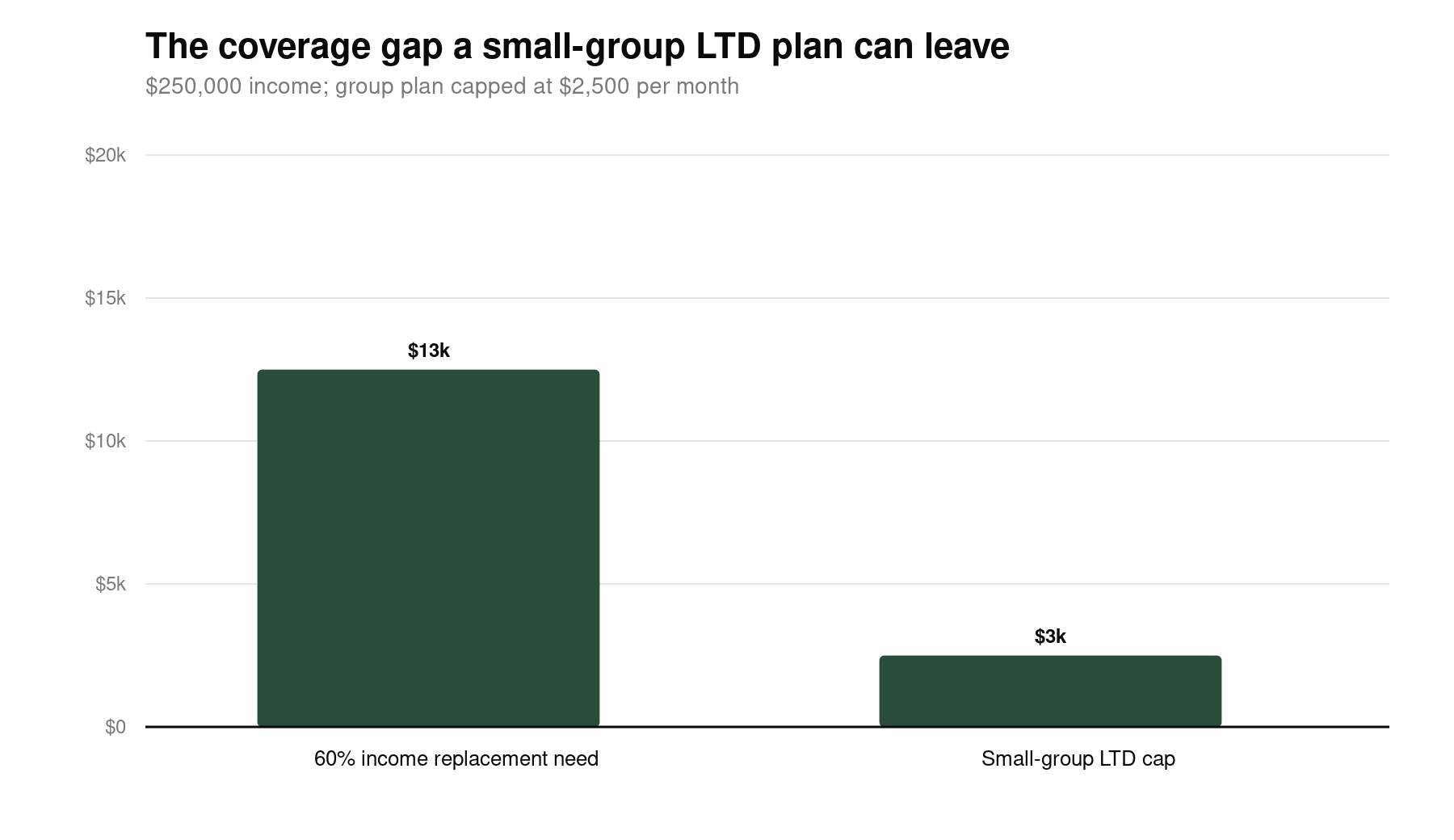
The first is the salaried professional with an employer group LTD plan who assumes it's enough. Group plans cap the replacement percentage at 50 to 66.66 percent of salary, but they also apply an overall dollar maximum on top of that percentage, and this is the number most people never check. Larger employer groups might offer a monthly maximum in the $10,000 to $15,000 range. Smaller groups, the kind you're more likely to find at a boutique firm or a professional partnership with a handful of employees, can cap out as low as $2,500 a month, regardless of how high the individual's income actually is.
Take an incorporated dentist earning $250,000 a year through a small associate practice, with a group plan capped at $2,500 a month. Sixty percent of her income works out to roughly $12,500 a month. The plan she has is covering about a fifth of what a full income-replacement calculation says she needs, and unless someone walks her through the plan booklet's actual maximum, she has no reason to know that.
The second path is more direct: no group plan exists at all. Many incorporated professionals and self-employed practitioners are, for insurance purposes, their own employer, and a one-or-two-person professional corporation rarely has the administrative infrastructure or member count to set up conventional group insurance. For this group, some insurers offer guaranteed issue long-term disability plans built specifically for low-risk occupational classes like lawyers, doctors, and accountants, structured as individually issued policies that function as an alternative to a group LTD plan.
These come with real restrictions of their own, including minimum group size, minimum average age, and a minimum annual premium commitment, so they aren't available to every solo practitioner, and where they aren't available, the fallback is a personally underwritten individual policy sized to income.
Professionals also tend to sit in the lowest-risk occupational classification insurers use, which is an advantage: it's what unlocks access to non-cancellable contracts and true own-occupation definitions in the first place. The irony is that the professionals who are best positioned to buy the strongest version of this coverage are often the ones who've never been asked whether they have any coverage at all.
The professionals who are best positioned to buy the strongest version of this coverage are often the ones who’ve never been asked whether they have any coverage at all.
Group and individual long term disability, side by side
| Group LTD (employer plan) | Individually owned LTD | |
|---|---|---|
| Who owns the policy | Employer (as policyholder) | You |
| Underwriting | Little to none for base coverage | Full medical and financial underwriting |
| Typical income replacement | 50-66.66% of salary | Up to about 60% of pre-disability income |
| Overall dollar maximum | Often $2,500-$15,000/month depending on group size | Set at issue, based on your income; can be increased later without new medical evidence via a future purchase option |
| Definition of disability | Usually shifts from own/regular occupation to any occupation after 12-24 months | Can be locked in as own occupation for the life of the contract, for qualifying occupational classes |
| Portability | Ends when you leave the employer (conversion sometimes available) | Fully portable; stays with you regardless of employer |
| Taxation of benefits | Taxable if employer paid the premium; tax-free if you paid it | Tax-free |
The taxation quirk that catches professionals off guard
If your employer pays 100 percent of the premium for your group long-term disability coverage, any benefit you eventually collect is taxable income under Canada Revenue Agency rules. If you pay the premium yourself, even under a plan your employer sponsors, the benefit comes to you tax-free. Because of this, well-designed contributory group plans are often structured so the employee pays the LTD portion of the premium specifically, even when the employer covers everything else, purely so the payout lands tax-free when it matters. If your plan doesn't work that way, that's worth flagging in a gap review, because it changes what your real, after-tax replacement income looks like by a meaningful margin.
Does having a corporation change the calculation?
Some incorporated professionals assume that because the corporation could, in theory, keep paying them a salary during a disability, personal long-term disability coverage is a lower priority. It's the wrong read on the risk. A corporation that has lost its primary revenue-generating professional for a year or more doesn't have unlimited cash flow to draw on; that's precisely the scenario business overhead expense insurance and disability buyout arrangements are built to address, and they're separate products from a personal LTD policy, not substitutes for it. The corporate structure protects the business. It does nothing, on its own, to replace the income you personally need to live on while you're not the one generating it.
What a gap review actually checks
If you have group coverage, the review starts with the plan booklet: what's the actual dollar maximum, not just the percentage, and when does the definition of disability change from own or regular occupation to any occupation. If you're incorporated or self-employed with no group coverage in place, the review is a straightforward calculation of income, benefit period, and elimination period sized to what you could self-fund in the meantime.
Either way, this isn't a shopping exercise. It's the same needs-analysis math a group plan actuary runs on a much bigger scale, just pointed at one household, and it's usually the fastest way to find out whether the coverage a professional believes they have and the coverage they'd actually need are the same number.
The fastest way to find out is a free Gap Assessment, a two-minute look at the size of your gap with no meeting required. If you are ready for the full picture, book a Gap Review and we will map it against your real numbers.
Frequently asked questions
What's the difference between long term and short term disability insurance? Short term disability covers the earlier phase of a disability, typically up to about 12 months, at a higher percentage of salary that's usually taxable. Long-term disability picks up afterward, generally at a lower percentage of salary but tax-free, running for a benefit period that can extend to age 65.
How long does long term disability insurance actually last? Individual policies commonly offer benefit periods of 2, 5, or 10 years, or coverage to age 65. Group long-term disability plans are typically structured to run to age 65 by default, provided the insured continues to meet the plan's definition of disability throughout.
Can I get long term disability insurance if I'm incorporated or self-employed? Yes. Some insurers offer guaranteed issue long-term disability plans for professional occupational classes like doctors, lawyers, and accountants as an alternative to a conventional group plan, subject to restrictions on group size and premium commitment. Where those aren't available, an individually underwritten policy sized to your income is the standard route.
Is long term disability insurance taxable in Canada? It depends on who pays the premium. If you pay the premium personally, whether on an individual policy or your share of a group plan, the benefit is tax-free. If your employer pays 100 percent of the premium, the benefit is taxable income to you.
What's the maximum benefit I can get from a group long-term disability plan? It varies by group size. Larger employer groups may offer a monthly maximum in the $10,000 to $15,000 range, while smaller groups can cap out as low as $2,500 a month regardless of the individual's actual income, which is where high-earning professionals in small firms most often find themselves underinsured.
Disclaimer
This article is general information for Canadian consumers, based on LLQP curriculum and public regulatory material. It is not financial, tax, or legal advice, and nothing here is a quote or guarantee. Any dollar figures, charts, or client scenarios used as examples in this article are hypothetical illustrations only, not based on real clients, and not tied to any specific insurer or product. Speak with a licensed advisor about your own situation.
About your advisor
Brenda Nkwocha and Hilda Chukwu are licensed life insurance advisors in Ontario. They lead with your gap, not a product: a straight look at what you actually have and what you actually need, explained in plain language before anything is recommended. This article is for educational purposes only and isn’t a quote, an offer, or personalized advice.
Two minutes now beats a guess you can’t take back.
See the size of your gap, then decide what to do with it.