Final Expense Insurance in Canada: What It Actually Is, and Who’s Overpaying for It


Educational content. Examples are hypothetical.
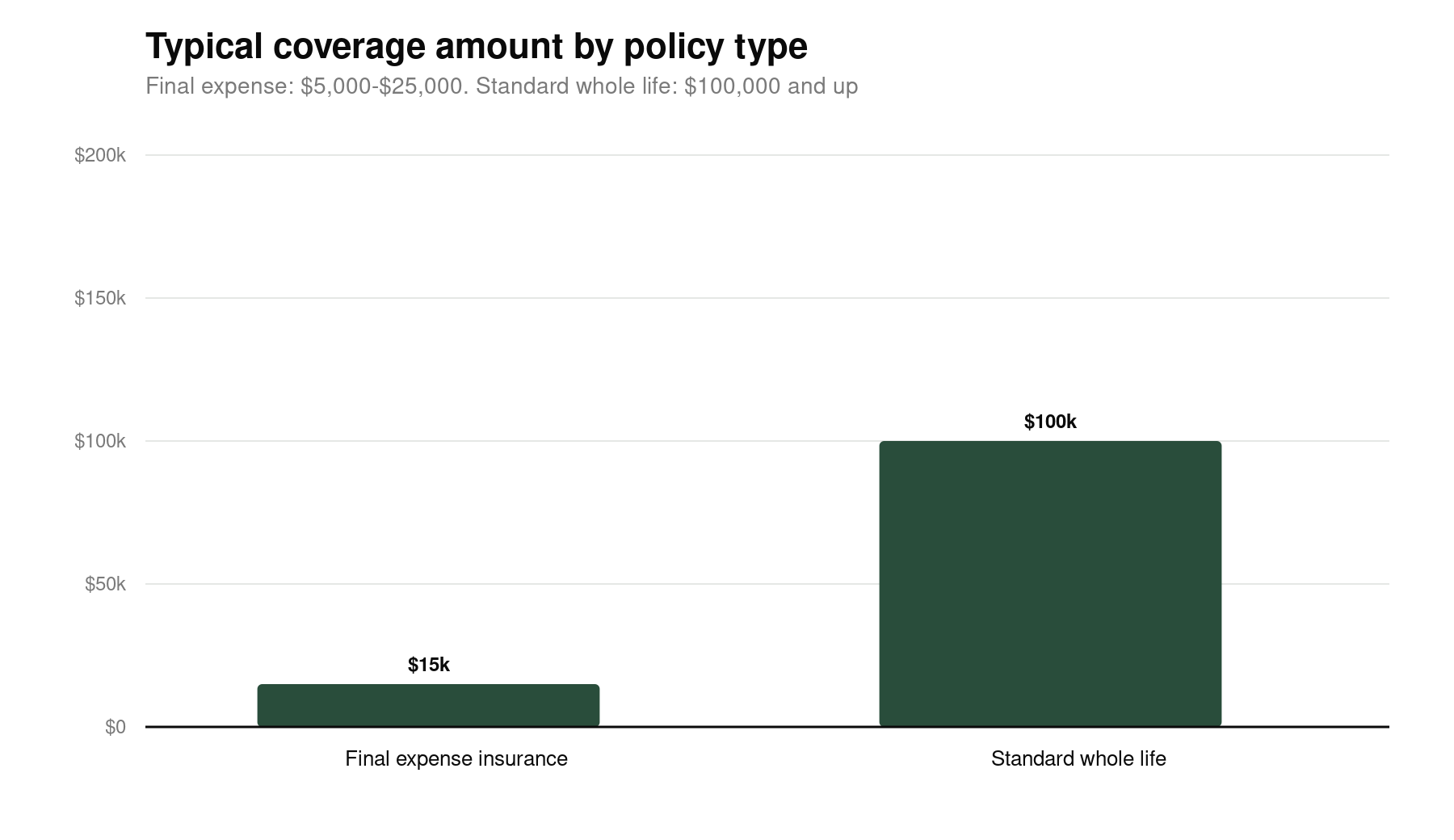
People in their late sixties or seventies often ask about "that funeral insurance you see on TV," usually after a call centre offered them guaranteed acceptance with no medical questions. Final expense insurance is a small, permanent whole life policy, typically $5,000 to $25,000 of coverage, sold specifically to cover funeral costs, outstanding debts, and other costs that show up in the weeks after a death.
It is real insurance with a real death benefit, and for the right person it solves a real problem. It is also, dollar for dollar, some of the most expensive life insurance sold in Canada, and a meaningful share of the people who buy it would do better with a standard policy or, in some cases, no policy at all.
What makes it "final expense" rather than just whole life
Nothing about the underlying contract is unique. A final expense policy is a whole life policy, which means it provides coverage for the entire life of the person insured, with a level premium and a level death benefit that never expires as long as premiums are paid. What distinguishes it in the marketplace is the underwriting and the size. Final expense products are almost always sold on a simplified issue basis: a short health questionnaire, no medical exam, and a fast accept-or-reject decision, rather than the fully underwritten process a $500,000 policy would go through.
Simplified issue underwriting does not sort applicants into preferred or standard risk classes the way fully underwritten policies do. Everyone who qualifies pays a rate built around a pool of people the insurer knows less about, and that uncertainty is priced into the premium. Some final expense products go further and offer guaranteed acceptance, meaning no health questions at all, which exists specifically for people who would otherwise land in the declined risk category and be unable to buy insurance through the normal channel.
Why the premium looks so high next to the coverage amount
This is the part that catches people off guard. A 70-year-old buying $10,000 of final expense coverage can end up paying a monthly premium that, annualized, looks disproportionate next to the face amount. Two things drive that. First, simplified and guaranteed issue policies carry higher premiums than fully underwritten policies precisely because the insurer has less information about the applicant's health and is pricing for a pool that includes people it would otherwise have declined or rated.
Second, whole life premiums for anyone in their sixties or seventies are inherently higher than the same coverage would have cost at 30, because the insurer is much closer to the point of paying the claim and has far less time to build the reserve that keeps a whole life premium level for life.
Neither of these facts makes the policy a bad product. They just mean the cost per thousand dollars of coverage is higher here than almost anywhere else in the life insurance shelf, and a buyer should walk in knowing that rather than being surprised by it.
Who actually needs this, and who's better off elsewhere
The client final expense insurance is built for has a specific profile: often in their late sixties, seventies, or eighties, wants a modest amount of coverage earmarked for funeral costs and small debts so family isn't left covering them out of pocket, and either can't qualify for a standard policy at a reasonable rate because of health, or simply wants the simplicity of no medical exam at this stage of life.
For that person, a guaranteed or simplified issue whole life policy in the $5,000 to $15,000 range is exactly the right tool. For someone whose only goal is making sure a spouse or adult children aren't scrambling to cover a funeral bill, a policy in that range can fit.
Where it goes wrong is when a healthier applicant buys final expense out of convenience rather than necessity, without ever finding out they'd have qualified for standard or even preferred underwriting on a regular whole life or term-100 policy at a meaningfully lower cost per thousand. Someone in their early sixties and in good health may be offered a guaranteed-issue policy by direct mail without anyone checking whether they qualify for something cheaper. It is worth asking before you sign.
If you're in reasonable health, the first question worth answering isn't "how do I get final expense coverage," it's "would I actually qualify for a standard whole life or term-100 policy," because if the answer is yes, that policy will almost always cost less for the same death benefit. Final expense makes the most sense as the fallback for people who can't get anything else, not as the default first stop.
Final expense makes the most sense as the fallback for people who can’t get anything else, not as the default first stop.
There's also a related situation worth naming directly: someone who recently received a life insurance payout or other lump sum after a spouse's death and is being pitched a new policy on themselves to "cover the funeral" isn't usually being served well by that pitch. If income and liquidity are the real gap, a safe income solution, not a new small insurance policy, is typically the better fit, and that's a conversation worth having before signing anything.
Final expense insurance vs a standard whole life policy
| Final expense insurance | Standard whole life | |
|---|---|---|
| Coverage amount | Typically $5,000 to $25,000 | Usually $100,000 and up |
| Underwriting | Simplified issue or guaranteed acceptance; short questionnaire or none | Fully underwritten; medical exam and history for larger amounts |
| Cost per $1,000 of coverage | Higher, reflects underwriting uncertainty | Lower for anyone who qualifies at standard or preferred rates |
| Best suited for | Those who can't qualify elsewhere, or want simplicity for a small, specific need | Anyone insurable who needs a larger death benefit for income replacement, estate, or legacy purposes |
| Cash surrender value | Builds slowly, same mechanics as any whole life policy | Same mechanics, larger dollar values given the bigger face amount |
Frequently asked questions
Is final expense insurance the same as pre-paid funeral plans? No. A pre-paid funeral plan is a contract with a funeral home for specific goods and services. Final expense insurance is a life insurance policy that pays a cash death benefit to a beneficiary, who can use it for funeral costs, debts, or anything else.
Do I need a medical exam for final expense insurance? Usually not. Most final expense products use simplified issue underwriting, a short health questionnaire with no exam, and some guaranteed acceptance products ask no health questions at all, though those tend to cost more per dollar of coverage.
Can my final expense policy be declined or cancelled later if my health changes? No. Once a life insurance policy is issued, the insurer cannot revisit your risk classification or raise your premium because your health has since declined. That protection applies to any life insurance contract, not just final expense products.
Is final expense insurance worth it if I'm in good health? Not usually as a first move. If you can qualify for standard or preferred rates on a regular whole life or term-100 policy, that coverage will typically cost less per thousand dollars of death benefit than a simplified issue final expense product.
Does final expense insurance build cash value? Yes. It's a whole life policy, so it builds a cash surrender value over time using the same mechanics as any other whole life contract, as outlined by the Canadian Life and Health Insurance Association, though the dollar amounts are naturally smaller given the smaller face amount.
Is final expense insurance right for you?
The honest answer depends on whether you'd qualify for something else first, and that's exactly what a gap review is for: a look at your full picture, health included, before deciding whether a small guaranteed-issue policy, a standard whole life policy, or something else entirely is the right fit for what you're actually trying to protect. The fastest way to find out is a free Gap Assessment, a two-minute look at the size of your gap with no meeting required. If you are ready for the full picture, book a Gap Review and we will map it against your real numbers.
Disclaimer
This article is general information for Canadian consumers, based on LLQP curriculum and public regulatory material. It is not financial, tax, or legal advice, and nothing here is a quote or guarantee. Any dollar figures, charts, or client scenarios used as examples in this article are hypothetical illustrations only, not based on real clients, and not tied to any specific insurer or product. Speak with a licensed advisor about your own situation.
About your advisor
Brenda Nkwocha and Hilda Chukwu are licensed life insurance advisors in Ontario. They lead with your gap, not a product: a straight look at what you actually have and what you actually need, explained in plain language before anything is recommended. This article is for educational purposes only and isn’t a quote, an offer, or personalized advice.
Two minutes now beats a guess you can’t take back.
See the size of your gap, then decide what to do with it.